Showing posts with label World War II. Show all posts

Wednesday, December 12, 2007

Band of Brothers

World War I's static warfare and the widespread, seemingly senseless carnage that that static warfare engendered, provoked a great deal of innovative military thinking in the interwar period. Doctrines for the effective use of massed armor and for strategic bombing were developed by members of Europe's armed forces, and these doctrines played a very important role in the course of fighting during World War II. Airborne infantry was another of these innovations. First demonstrated in Italy in 1927, airborne units eventually formed parts in the armies of all major combatants; and these airborne units were regarded by their armies and by the forces that fought them as elite. German paratroopers were an integral part of the invasion of Crete in 1941, and massed landings of American and British paratroopers played a part in every major Allied offensive in North Africa and Western Europe. Modern armies continue to contain airborne units, but because of the experience in World War II with massed landings, most have evolved their doctrine for their use. The German paratroopers on Crete suffered huge casualties, and Allied landings were plagued by an inability to get the troopers to the drop zone consistently and efficiently.

The two most famous airborne units in the United States Army during World War II (and after) were the 82nd and 101st Airborne Divisions. Elements of the 82nd Airborne fought in North Africa, Sicily, Italy, France, Belgium, and Germany. The 101st fought exclusively in the northern European campaign initiated by the landings at Normandy in 1944. We typically think of airborne units as being exclusively composed of parachute infantry, but both of these divisions also had glider infantry and parachute artillery units. Both divisions were (and are) elite and amassed an amazing combat record during the war. By far the most famous exploit was the 101st's defense of Bastogne during the Battle of the Bulge in December 1944. Bastogne was an important crossroads town in Belgium that stood in the way of the German advance on Antwerp; and the 101st was one of the only units available to reinforce the line when the Germans attacked. Eisenhower ordered them trucked to Bastogne, even though they didn't have sufficient winter clothing or ammunition and were understrength from their fighting in the Netherlands in September and October. They were quickly surrounded, but they managed to hold the town under a relentless German attack until George Patton's Third Army broke through to reinforce and resupply them on December 26. The 101st received a Presidential Unit Citation for their defense of Bastogne, the first time that an entire division had ever been so honored.

The most famous unit within the 101st Airborne Division was Company E of the 506th Parachute Infantry Regiment. Company E's fame is partially due to its fighting record during the war, which was excellent, but mostly because Stephen Ambrose wrote a book about it (Band of Brothers: E Company, 506th Regiment, 101st Airborne From Normandy to Hitler's Eagle's Nest). I wish that I could say that the book is good, but I can't. It's execrable. The writing style is turgid, there are numerous narratives errors, and it reads more like hagiography than an honest history of the unit and the men who served in it. Fortunately, they made a movie based on the book (or, rather, an HBO miniseries); and in this case, the movie is much, much better than the book. There are 10 episodes following Company E's progress from training at Camp Toccoa in Georgia to preparations for the Normandy landings in England to the Normandy campaign, Operation Market Garden, Bastogne, and the surrender of Germany. It has the same battlefield realism that Saving Private Ryan is noted for, but its storyline and characters strain the bounds of credulity much less than that movie did. It's moving, entertaining, and educational, probably the finest World War II motion picture that I have ever seen. And would you believe that Donnie Wahlberg can act? (He plays Carwood Lipton, Company E's First Sergeant during the Bastogne campaign, and does so very well.)

Tuesday, December 11, 2007

On This Day

On this day in 1941, Adolf Hitler declared war on the United States. The question that historians (at least American historians) always ask is why. It is true that Hitler was not really required to do so. The German-Italian-Japanese Tripartite Pact that was signed in September 1940 was a defensive alliance, and the war that came between Japan and the United States on December 7, 1941 most assuredly was a result of offensive action by Japan. In fact, knowing that the Tripartite Pact did not require Germany to go to war, both Churchill and Roosevelt were extremely concerned that Hitler would not declare war. Both regarded Germany as a much more pernicious threat to the world than Japan, and both knew that the American public would not support an American declaration of war against Germany after Pearl Harbor. Roosevelt desperately wanted the US involved in the European war, and Hitler bailed him out. Hitler's decision is usually presented as an unaccountable blunder that virtually assured German defeat in the war. It was undeniably a blunder, but, as Ian Kershaw points out in his new book Fateful Choices: Ten Decisions That Changed the World, 1940-1941, it wasn't exactly an unaccountable one.

Kershaw argues that one must remember the context of Hitler's decision. By early December 1941, the German attack on the Soviet Union had bogged down, and it was clear that Hitler's gamble that he could crush the Soviets in 1941 had lost. The Soviets began their counteroffensive, which came very close to breaking the German army, on December 5. Hitler was desperate to get the Japanese into the war, against the Soviets ideally but against the British if need be. Furthermore, while the United States and Germany were not technically at war before Hitler made his declaration, they almost might as well have been. In fact, the United States had been waging undeclared war in the north Atlantic since fall. The Kreigsmarine had been begging Hitler to allow them to begin unrestricted submarine warfare (indeed, just to fire back when US Navy ships tried to sink them) for months. He had held them off, but it was clear that he couldn't forever. So, put yourself in Hitler's position. Declaring war binds Japan more closely to the Axis and may eventually induce them to go to war with the Soviet Union, at a time when the war with the Soviet Union isn't exactly going well. What's more, Germany is already at war with the US in all but name. What difference does it make to make it official? That's likely what Hitler was thinking, and it has a certain logic to it. It doesn't change the fact that it was a blunder, but the blunder was understandable.

Sunday, November 11, 2007

On This Day

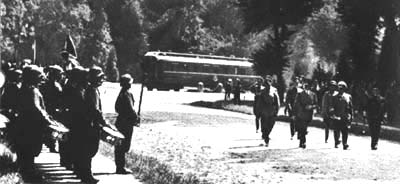
On this day in 1918, representatives of the German government and military signed the armistice document dictated to them by Marshal Ferdinand Foch, supreme commander of Allied forces, in Foch's wagon-lit railway car on a siding in the Compiègne Forest, thus bringing combat in World War I to an end. France later turned the wagon-lit into the centerpiece of a war memorial. When the French requested an armistice with Germany in 1940, Hitler had the wagon-lit removed from the memorial and forced the French to sign the document he dictated in it. (The picture above is of Hitler leaving the wagon-lit after the French capitulation.) Germany then took possession of the car, and it was destroyed by the SS in April 1945 as the end of World War II approached.

Saturday, November 10, 2007

On This Day

On this day in 1938 (actually, the night of November 9-10), the Nazis in Germany perpetrated Kristallnacht, a state-organized and controlled pogrom that aimed to terrorize the German Jewish population and to remove Jews from German economic life.

The pretext for the pogrom was the shooting of Ernst vom Rath, a junior diplomat at the German embassy in Paris, by Herschel Grynszpan, a German-Polish Jew currently resident in Paris, on November 7. Grynszpan's family were among the Polish-born Jews resident in Germany that were expelled on October 28, 1938. The Polish government initially refused to allow them into Poland, and they were forced to live in no-man's-land between the German and Polish border crossings in deplorable conditions for several days. Eventually, the Polish government relented and allowed the refugees to live in camps inside Poland, where conditions were only slightly less deplorable than they were in no-man's-land. Grynszpan received a letter from his family describing their plight, and he sought revenge on the first German official that he saw.

Vom Rath died of his wounds on the evening of November 9 as Adolf Hitler was preparing to address the Nazi party faithful on the anniversary of the Beer Hall Putsch. The timing could not have been more fortuitous. Hitler ostentatiously left the hall without speaking, and Joseph Goebbels, the Propaganda Minister, announced that Vom Rath had died and that anti-Jewish demonstrations should not be organized by Party officials but that they should be allowed to take place "spontaneously" without interference. It was an obvious signal that Hitler wanted the demonstrations to take place and that he wanted the Party to take part. And take part they did. Thousands of Jewish-owned stores were destroyed (the name of the pogrom, Kristallnacht, refers to the broken plate-glass windows of those stores), and nearly every synagogue in the country was damaged or destroyed. Countless Jews were roughed up, and 91 were murdered. Some thirty thousand were arrested and sent to concentration camps. The whole thing was organized and controlled by elements of the German government (primarily the SS and the Gestapo) with an eye toward preventing non-Jewish property from being damaged and Jewish property from being looted (at least by private individuals).

In the aftermath of the riots, the German government adopted a number of new anti-Semitic measures, including a collective fine on the entire Jewish population for Grynszpan's crime, the confiscation of all insurance payouts to Jews for the damage done by the riots, and the expropriation of Jewish property.

Wednesday, November 7, 2007

Was Yamamoto Rational?

In the months and years prior to the Japanese attack on Pearl Harbor, the American military was very aware of the potential danger that the Japanese navy posed to the harbor and to the ships based there. As early as 1933, joint Army-Navy maneuvers were predicated on a Japanese attack on Pearl Harbor; and by early 1941, as tensions with Japan mounted, Lieutenant General Walter Short, commander of Army forces in Hawaii and responsible for the physical security of Pearl Harbor and of the US Pacific Fleet when it was present there, and Husband Kimmel, commander-in-chief of the US Pacific Fleet understood that Pearl Harbor could very well be on the Japanese navy's list of targets if war came. Short especially was acutely aware of the difficult position that a defender of Pearl Harbor was in. There weren't enough long-range reconnaissance planes to conduct continuous 360-degree patrolling to alert Pearl Harbor's defenders of an enemy attack before it struck, and early warning was essential to all of the defense plans that he and Kimmel had. And yet the Japanese took Kimmel, Short, and just about everybody else in the US military establishment by surprise when they struck on December 7. Why? I'm sure that there are a number of reasons for this, but one of them had to have been the deep-seated conviction by most members of the US Army and Navy that the Japanese had the initiative or the ingenuity to pull such an attack off and that, even if they did, they never would because doing so would be irrational: a war with the United States made no sense because the industrial capacity of the United States was so much larger than that of Japan. The United States was destined to win any protracted conflict.

To be honest, I don't know how widespread this attitude is in current historical literature; but it is something that I have read and heard before. However tactically brilliant the attack on Pearl Harbor was, it was a strategic disaster that ultimately spelled the destruction of imperial Japan. Well, I don't think that this argument is persuasive. Consider the position that Japan found itself in at the end of 1941. The United States had cut off its supply of oil and scrap metal in response to Japanese aggression in China, and the Japanese war machine relied on those raw materials. The embargo placed Japan in a very tough position: either they could forswear their imperial ambitions in China and elsewhere in Asia, or they would have to find another source of oil and iron. Realistically speaking, getting oil meant invading the Dutch East Indies and other territories in the Southwest Pacific. That would mean war with the United States. So the choice was either to give up or go to war with the United States. There was no way that the Japanese of the ruling classes would have given up, so that implied war. Isoroku Yamamoto, the commander-in-chief of the Japanese Combined Fleet and the guiding light of the attack on Pearl Harbor, may not have wanted war with the United States; but he absolutely wanted to maximize his country's chances of winning it if it came. He knew that the US almost certainly would win a protracted conflict, but an attack that crippled the US Pacific Fleet would allow the Japanese to take control of the Southwest Pacific and put them in a better position to resist the inevitable American counterattack. The more difficult that counterattack was, the more likely it was that eventually the US would give up and leave the Japanese to their new territory. Destroying the US Pacific Fleet gave the Japanese the best chance to win a war with the US, and from their perspective, they had to fight the US or be humiliated. That the attack did not allow the Japanese ultimately to succeed does not means that it was irrational or ill-considered. (Which is not to say, of course, that it was not still perfidious.)

Sunday, August 26, 2007

Why William Shirer Drives Me Nuts

Ben comments on last Thursday's post about the German-Soviet Non-Aggression Pact of 1939:
Incidentally, you might be very interested in a talk Max Hastings gave at Pritzker Military Library recently. At the end he gets asked some obnoxious question by a Stalin apologist and reminds the slug of the Molotov Ribbentrop Pact to shut him up. The MP3 is here.

Max Hastings is a British military historian, and the subject of the talk was Armageddon, his book about the end of World War II. I have not read the book, but the talk is excellent; and if the war interests you at all, you should spend the hour to listen to the talk. In the talk, Hastings makes a number of points about Stalin, the Red Army, its leaders, and its conduct in Poland after the war. Stalin, he says, was a far more effective warlord than was Hitler, largely because the Red Army's debacle to start the war taught him to leave all but the highest-level military questions to the men who actually knew about them, whereas Hitler never realized that he wasn't a military genius. He was a much more dangerous man for a general to work for, though, because he had a propensity for shooting generals, both because they failed and because they succeeded too well; Hitler, by contrast, didn't execute many of his army officers. The leaders of the Red Army by the end of the war, especially Georgy Zhukov, were the most effective generals of World War II, but they were effective largely because they were brutal and utterly unconcerned about the lives and well-being of their men. The Red Army was the most effective of the Allied armed forces, killing far more Germans and destroying far more German materiel than the Western Allies. Of course, their conduct in Germany at the end and after the war was nothing short of bestial, and they conducted a similarly brutal campaign after the war in Poland to exterminate all Poles who might object to Soviet domination. Listening to all of this, strangely enough, reminded me of why I can't stand William Shirer.

Shirer was the German correspondent for CBS radio for many years, ending with his expulsion from Germany in 1940. His Rise and Fall of the Third Reich, first published in 1959, remains the most widely-read popular history of the rise of the Nazi Party and the German conduct of World War II. Critics at the time and since have dismissed it as crude oversimplification of the Nazi era, but it is extremely readable; and I think that Shirer's opinions about the why the war came, even if not particularly original, were at the time and remain influential among the moderately well-read and well-educated American population. For Shirer, the causes of World War II are very simple: Germany fell under the control of a bunch of ruthless gangsters bent on world domination, and Britain and France were too cowardly to oppose them and too benighted by anti-Communist prejudice to recognize that alliance with the Soviet Union was, by the late 1930s, the only way to stop German aggression. He's certainly right about the first part: Germany did indeed fall under the control of a bunch of ruthless gangsters bent on world domination. The other two parts of his formulation are much more problematic. His account of British and French motivations for the policy of appeasement is much too simplistic and cartoonish, but that's not what I want to talk about here. It's his portrayal of the Soviet Union as the last, best hope of averting war.

On one level, Shirer is probably correct that an alliance between Britain, France, and the Soviet Union would have averted or at least delayed the beginning of World War II: had Hitler thought that the Soviets would have fought him if he invaded Poland, he probably wouldn't have invaded Poland on September 1, 1939. But what Shirer doesn't really address is whether the Soviets were negotiating with the Western Allies in good faith in 1939, whether it was really possible for them to have concluded an alliance on terms that would have been acceptable to both sides, and what the consequences of such an alliance would have been on the countries of Eastern Europe.

Was Stalin negotiating with the Western Allies in good faith in 1939? I doubt it. Leave aside the fact that Stalin had contemplated an accommodation with Hitler as early as 1936 during the Spanish Civil War, the fact that there was a history of German-Soviet cooperation dating to the 1920s, when the Soviets allowed the German army to train on Soviet territory to evade the restrictions of the Treaty of Versailles, and the fact that German and Soviet intelligence and espionage services began cooperating and sharing information as early as 1937. Stalin's sine qua non for an alliance with Britain and France was that Poland give the Red Army transit rights across Polish territory to engage the German Army, and he knew very well that that was a condition that the Polish government could never agree to. This reluctance by the Polish government to allow Soviet troops into their territory, far from being the obstinate ineptitude that Shirer portrays it as, was entirely rational. The Poles were in an impossible situation in 1938 and 1939. Their only legitimate hope to defend against German aggression was to get help from the Soviets, but they knew that Soviet help would inevitably mean Soviet domination. Shirer never mentions that the Red Army was at the gates of Warsaw during the Soviet-Polish war of 1919-1921 (Stalin was one of its commanders during that war) and that only a miracle comparable to that of the Battle of the Marne prevented them from taking the city, nor does he acknowledge that the Soviet domination that the Poles feared actually happened after World War II. And remember that almost half of inter-war Poland was territory formerly belonging to the Russian Empire. The Polish government knew that their position was impossible, and they chose to deal with their predicament with dignity: they refused to cave in to German bullying, and they refused to hand their country over voluntarily to the Soviets. It was stubbornness, I suppose, but it was a noble stubbornness, regardless of what Shirer says. An alliance with Stalin would have meant British and French complicity in Soviet aggression against Poland, Romania, Estonia, Latvia, and Lithuania. It was one thing for Britain to agree to this when it was a fait accompli, as it was by the time of the Yalta conference in 1945. It was quite another for them to do so in 1939. A British government that agreed to such an alliance would have fallen, and it would have deserved to do so.

Shirer's basic problem is that he doesn't regard Stalin and the Soviet regime as being evils on the same plane as Hitler and the Nazi regime. It doesn't make a whole lot of sense to try to determine which was the more evil, but it is unquestionable that both were directly responsible for the intentional infliction of huge amounts of death and human suffering. It is perfectly natural that any government not evil would have shrunk in the late 1930s from allying with either regime, and Shirer's refusal to understand that renders him obnoxious and his book tendentious.

(I am too lazy to quote from The Rise and Fall of the Third Reich in support of my arguments, but see the chapters "The Turn of Poland" and "The Nazi-Soviet Pact".)