

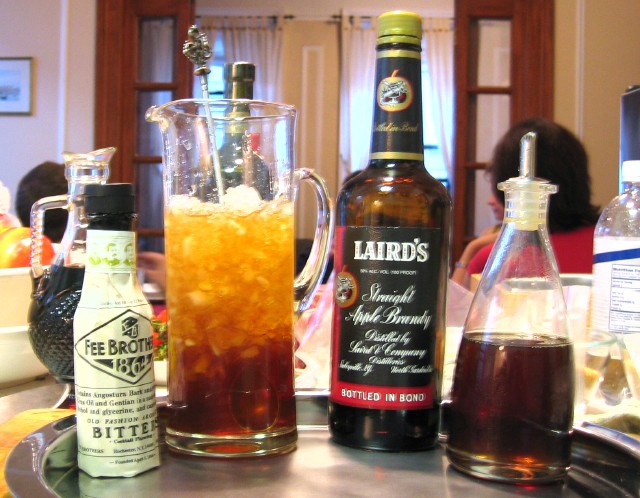
 Another difference between Laird's Straight Apple Brandy and Calvados (and American imitators of Calvados): just as Scotch and other foreign whisk(e)y frequently comes in tinted green bottles, so too does Calvados and Calvados-style apple brandy. Laird's comes in a clear glass bottle, just like virtually all quality American whiskey. And why not? It apparently is aged in new charred oak barrels just like American straight whiskey, so it has a nice deep amber color that's a heck of a lot prettier than dark green bottle glass. Just another reminder that while Laird's is apple brandy (and obviously so), it's a distinctively American approach to it.
Showing posts with label apple brandy. Show all posts
Showing posts with label apple brandy. Show all posts
Sunday, October 21, 2007
Last Night's Tipple
Another difference between Laird's Straight Apple Brandy and Calvados (and American imitators of Calvados): just as Scotch and other foreign whisk(e)y frequently comes in tinted green bottles, so too does Calvados and Calvados-style apple brandy. Laird's comes in a clear glass bottle, just like virtually all quality American whiskey. And why not? It apparently is aged in new charred oak barrels just like American straight whiskey, so it has a nice deep amber color that's a heck of a lot prettier than dark green bottle glass. Just another reminder that while Laird's is apple brandy (and obviously so), it's a distinctively American approach to it.


Saturday, October 13, 2007
Last Night's Tipple
 There are those who say that Americans should try to make American-style alcoholic beverages, not to attempt to ape European-style ones. The most obvious example of this argument is Paul Draper from Ridge Vineyards, who has famously emphasized American grapes like Zinfandel and Petite Sirah (American grapes in the sense that they have not been major wine-making grapes anywhere but in America for the past 100 or 150 years, not in the sense of ultimate origin) as part of field blends like Lytton Springs and Geyserville and even more famously ages all of his wines, including his top-of-the-line Cabernet Sauvignon (Monte Bello) in American oak instead of French oak. Though this argument is less prominent in the world of spirits, it's still there. Chuck Cowdery, who is a prominent writer about American whiskey, thinks that it is absurd for American distilleries to try to make Scotch single-malt-style whisky. We've evolved an excellent whiskey-making tradition in America, he says, just as the Scots have in Scotland. We should honor our own traditions, not automatically think that they're inferior to the traditions in other countries.
Paul Draper and Chuck Cowdery might not like the motivation behind Clear Creek Distillery's Eau de Vie de Pomme, then. Clear Creek is in Oregon; and Steve McCarthy, Clear Creek's distiller, is explicitly trying to rival the best Calvados with this product. He distills it using an alembic pot still, just like Calvados. He ages it in ex-Cognac casks, just like Calvados. The time in barrel is 8 years, which is common among better Calvados. The only difference, aside from his scale of production, is that he uses local Golden Delicious apples rather than the Norman cider apple varieties like Rouge Duret, Ramboult, Mettais, Saint Martin, and Frequin (thanks, Wikipedia!) that Calvados producers use. And, indeed, the result is a very Calvados-like apple brandy. It's more lightly-colored than I remember Calvados of similar age to be and it has less of the unctuous caramel-cinnamon flavors that the best Calvados has, but it is very good. The only thing that I have to complain about is the fact that every now and then, I get an aroma like nail polish remover, which is off-putting. It's not consistent, though, which is a good thing. While I respect the argument made by Draper and Cowdery and while I think many Americans could benefit from not reflexively assuming that European is equivalent to better, I can't fault anyone who wants to make apple brandy that tastes like Calvados, which is undoubtedly one of the world's most sublime spirits. This brandy is not inexpensive at $21 for a 375 ml bottle, but it is a very good attempt.
Friday, September 7, 2007
Last Night's Tipple
Another pour of Laird's BIB Straight Apple Brandy. I remain impressed with it. Lots of apple aromas, and many of the barrel-related characteristics that aging in charred new oak barrels causes. Very different from Calvados, but an enjoyable expression of apple brandy in its own right. I would like to try Laird's older apple brandies, but, alas, they're not available in this area, to the best of my knowledge.Speaking of American apple brandy, see Will's post at A Suitable Wardrobe about Clear Creek Distillery's Eau de Vie Pomme, which, although distilled in Oregon, is made in the Calvados style. I have seen a 375 ml. bottle of this at Spec's in Houston (around $21), and I have been tempted more than once. After reading what Will has written about it, I'm sure that I'll buy it sooner rather than later.
Monday, July 23, 2007
Last Night's Tipple
One of the things that I find wondrous about high-quality spirits is that they are chameleon-like: they present different facets of their personalities at different times, depending on the conditions under which they are tasted and the moods of the taster. When I tried Laird's Straight Apple Brandy back in June, I wrote that it tasted like apple whiskey, meaning that it had the same aromas and flavors from its barrel aging that I associate with American whiskey (namely, char and vanilla). When I tasted it last night, the char and the vanilla were still there, but my dominant impression was of fresh apples, with cinnamon and nutmeg in the background. It reminded me of a young Calvados, to be honest, something that I didn't think was possible. It was a totally different experience, but similarly satisfying.
Thursday, June 28, 2007
Last Night's Tipple
Did you think that the adjective "straight" (as it pertains to spirits) could only be applied to whiskey or that only a whiskey could be bottled in bond? So did I. But I was wrong, so wrong. "Straight" can apply to any spirit type and means that the spirit has been distilled to no more than 160 proof and has not been mixed with any grain neutral spirits. In the case of straight apple brandy, I would imagine that the mash that it's made from would have to be at least 51% apples, but I don't know what else could be in the mash. Pears? Grapes? Grain? (I know: grain sounds revolting, but who knows?) And any spirit can be bottled in bond, provided that it is made at one distillery in one season, aged for at least four years in oak casks, has not had any flavoring or other adulterant added to it, and is bottled under government supervision at 100 proof. So it is thus possible for Laird's to produce Laird's Straight Apple Brandy, Bottled in Bond. The label says that it is bottled at DSP-NJ-1, Laird's Scobeyville, NJ facility. For some reason, it doesn't say where it was distilled, although Laird's website says that all distillation is now done in North Garden, VA.Applejack has a venerable tradition in the United States, particularly in the Northeast. In colonial times, people would leave barrels of hard cider out during the winter and repeatedly skim off the ice that formed inside. Because alcohol has a much lower freezing point than water, the skimmed ice would be mostly water, which would have the effect of increasing the concentration of alcohol in the liquid that remained. This method of production is called fractional freezing. The problem with it is that ethanol is not the only kind of alcohol in hard cider that is concentrated by fractional freezing. Fermentation of apples (and of grains and other fermentable substances) does not just produce ethanol. It also produces small quantities of methanol and fusel alcohols, which are highly toxic. They're not a problem in hard cider or beer or wine, but they are a problem in a spirit produced by fractional freezing. Nobody with any sense makes spirits this way any more, and it has been thus for more than two hundred years.
The Laird family has been making applejack since 1698. Their first commercial production was in 1780, making them the oldest still-operating American distillery. Up until the 1970s, their applejack was pure apple brandy; but they have since blended it with grain neutral spirits to lighten its flavor and reduce their costs. Their bottling labeled applejack is currently about 35% apple brandy and 65% GNS. They label all the pure apple brandy as apple brandy instead of applejack. The BIB bottling that I tried last night is probably four years old or maybe a bit older. There are also 7.5 year old and 12 year old versions. All of Laird's apple brandies are aged in charred oak barrels, which brings me to my initial impression of the BIB: it's like apple whiskey. I can't claim credit for that phrase, but it is accurate. The barrels give the brandy lots of char and vanilla aromas, just like Bourbon. There's also a distinctive apple juice aroma, but the char and vanilla dominates. On the palate, it's fruit-dominated, sweet, and a little rough. It could use more time in the barrel, but it is pleasant.
Oh, and it is nothing at all like the Calvados that I had a few days ago. I'm eager to try the Laird's 12 YO to see if the age gives it more of a Calvados character. But this is enjoyable enough for what it is. *
* And before Mamacita points it out, yes, I did try this out of a plastic cup while watching fireworks at New Year's; and I didn't like it much then. Of course, drinking anything out of a plastic cup is not perfectly calculated to show it at its best advantage. It was much better last night.
Subscribe to:
Posts (Atom)
