Monday, March 3, 2008

Last Night's Tipple

Bonarda is Argentina's second most widely-planted grape, after malbec. There is considerable uncertainty about what the Argentine bonarda actually is. It is vitis vinifera, of course, which means that it originated in Europe or the Near East, and the name is Italian. The problem is that there are three different Italian grape varieties known as the bonarda, and there is evidence that the Argentine bonarda is none of these but instead might be the charbono. The matter could be settled by DNA testing, just like the research that proved that California petite sirah was mostly the grape known as durif in France. But Argentina doesn't exactly have the highest prestige level of all wine-growing countries, and bonarda doesn't exactly have the highest prestige level of all the grape varieties grown in Argentina. Ampelographers simply haven't gotten to it yet.

Most of the Argentine wine that one sees on the US market are either malbec or one of the mass-appeal varietals like cabernet sauvignon or merlot. Bonarda bottlings are a little uncommon, but they can be found. I had heard about bonarda; and since novelty always appeals to me, I decided to seek it out. Spec's had two or three different versions, none of which I knew anything about. I selected the 2006 La Posta Estela Armando Vineyard Bonarda largely because I liked the label (when there is nothing else to judge a wine by, why not just go by the label?). The importer's website says that the grapes for this wine are from 45 year old vines cultivated by a family of Italian ancestry. There is a good deal of fruit on the nose, mixed with some earthiness and smoke. Towards the end of the glass, I thought that I smelled a bit of raspberries and cream and a bit of toast (as in Wonder bread). There was a lot of red fruit on the palate, along with a good deal of drying tannins. The finish wasn't particularly long, but that's okay. This was a concentrated and enjoyable wine. I think that it was a little overpriced at $16 a bottle, but trying new things is almost always a good idea.

Sunday, February 24, 2008

Today's Shoes

Alden half-brogue bluchers in dark brown long-nap suede with combination leather/rubber soles -- Alden calls them Commando soles, and they're actually full leather soles and heels with mini-lug rubber soles glued and stitched over them (Barrie last). These shoes were a special order that I placed years ago with Alden of Carmel. Alas, Alden actively discourages special orders now, and most retailers won't do them because of Alden's hostility.

Last Night's Tipple

Man, that picture didn't come through well at all. Oh, well. That's the best I can do.

Anyway, continuing with the dolcetto theme, last night I opened a bottle of 2005 Chionetti Dolcetto di Dogliani San Luigi. The DOC is Dolcetto di Dogliani, and San Luigi is the name of the vineyard where the grapes were grown. In the Dolcetto d'Alba DOC, dolcetto is usually a secondary or tertiary grape, planted in less favorable locations by growers who reserve their best spots for nebbiolo and barbera. This is less frequently the case in the Dolcetto di Dogliani DOC -- more frequently, growers plant dolcetto and only dolcetto. This naturally causes them to take the grape more seriously than do some growers in the Dolcetto d'Alba DOC, and people who actually know something about this say that Dolcetto di Dogliani wines are typically heavier, more intense, and more age-worthy than Dolcetto d'Alba wines. Quinto Chionetti is a respected Dogliani producer, and he makes three single-vineyard dolcettos: Briccolero, Vigna la Costa, and San Luigi. My friendly, neighborhood liquor and wine superstore only carries the San Luigi, so that's all I can try (although I think that it would be fascinating to compare all three). It cost around $24 a bottle, making it about as expensive a dolcetto as you can find.

When first poured, this wine didn't have much aroma at all. With some vigorous swirling, however, it really opened up. When it did, it had the same copper penny aroma as the Gagliardo I had previously. In addition, there was a big rose petal component and some meatiness. Yes, meatiness. I'm not sure exactly which meat -- maybe ham, maybe bacon -- but it's there. I like it a whole lot. On the palate, there's a lot of dark fruit and a lot of drying tannins. With the Gagliardo, at first it was a bit short -- I swallowed it, and it was gone. That changed with some time in the glass, but it was a bit disconcerting nonetheless. That wasn't a problem with this Chionetti. I like this wine a lot. I wouldn't go so far as to say that it was a great value, but it was very tasty; and I did enjoy it more than the Gagliardo (although they were close).

Saturday, February 23, 2008

Golf

Anybody who has played golf on a Sunday knows that middle-aged men are the scourge of fast play. Not all of them, of course, and they are hardly the only offenders. However, far too many of them apparently believe that they have the skill level of Tiger Woods and that the rounds they are playing are as consequential as the final round of the Masters. On a typical hole, they will wait until the group ahead of them is 300 yards down the fairway before hitting their tee shots, which will almost invariably be dribbled into the rough maybe 100 yards. They will then wait for the group ahead to finish on the green before hitting their second shots, even though it would take a Woods-like effort with a one iron to reach the green. When they finally do hit their second shots, they will likely be 75 yard worm-burners that go another 75 yards in the rough. It will continue like this for another two or three shots until they are finally on the green, at which point the real slow-down begins. All putts must be examined from at least three different perspectives for not less than a minute at each perspective, and it is impossible for more than one player to line up their putts at the same time. The average round of golf on the weekend will take close to five hours, and this kind of slow play is the cause of it.

The Wall Street Journal February 16 Golf Journal column points out another factor leading to slow play, namely, course design:

The average drive of a 90s-shooting male golfer is 192 yards. He thinks he hits the ball 30 yards farther than that, according to a survey of more than 18,000 golfers completed three years ago by Frank Thomas, the former technical director for the U.S. Golf Association. In fact, the survey found that 41% of men estimate they hit their drives 250-plus yards, which hard data from club manufacturers expose as total balderdash; in reality, maybe only one in 50 golfers routinely hits drives 250 yards. Senior men are lucky to coax 170 to 180 yards out of their tee shots. Typical female golfers drive about 135 yards.

If golf were somehow to reinvent itself from scratch, reflecting how the vast majority of participants actually play the game today, the default tees at courses would play at 5,700 to 6,300 yards. The forward-most tees, for beginners, some seniors and some women, would be at around 4,100 yards and get lots of use, and some courses would provide alternative tees set at, say, 6,700 and 7,200 yards, for the relatively few crack youngsters and low single-digit handicappers who can comfortably manage that length. (Scratch golfers constitute only 0.65% of the total.) ("A Tee Too Far: Long Courses Overmatch Golfers; Trying a New Way" by John Paul Newport, p. W1)


There is a lot of sense in this approach to golf course design; and if golfers would comply, it would improve the golfing experience for everyone. The actual golfers would be happier because they would actually have a chance to play the course like it was designed to be played. They players around them would be happier because the speed of play would improve dramatically. But the first paragraph that I quoted points out the problem: the average golfer thinks that he's lot better than he actually is. He reads the coverage of the US Open, which tells about how the course being played this year will be 7,600 yards long. Not only does he think that he can play a 7,600 yard course, he is also insulted if you put tees out there for him to use that are only 5,400 yards. Delusions of grandeur are the main problem; golf course design is a subsidiary concern.

Today's Shoes

Gravati unlined three-eyelet plain-toe blucher boots in snuff suede with microcellular rubber soles (16899, 697 last). In recent years, Gravati, like all of the other Italian makers, has introduced elongated lasts, both square-toe and round-toe. Styles are changing a bit, and the most recent Gravati lasts are backing off of the elongated look a little bit. 697 is a new last, and it's not as snouty as some of the lasts from the past few years. Still, though, it is a bit snouty -- about 3/16" less length would be perfect. It otherwise is a very shapely and attractive last -- I like what Gravati has done here.

Last Night's Tipple

I finished the bottle of 2005 Gagliardo Dolcetto d'Alba last night, and it was as good or better than it was when I opened it the night before. This wine had a shelf talker recommendation from the Central Market wine buyer, and I will admit that that was what determined me on my purchase. The packaging seemed a bit too cutesy and marketing-driven for comfort; but when confronted with 7 or 10 wines of the same variety, all of similar price and none of them familiar, why not pay attention to a staff recommendation for one?

Dolcetto is frequently referred to as the Italian version of Beaujolais in introductory wine books, and it's a comparison that causes umbrage for both proud Dolcetto producers and proud Beaujolais producers. The wine writers typically mean that both Dolcetto and Beaujolais are (relatively) cheap, soft, easy drinking wines best consumed young. In other words, they mean the comparison to be mildly pejorative or at least patronizing. Well, anyone who has ever tried Domaine Diochon Moulin-a-Vent or most of the other Beaujolais wine that Kermit Lynch imports knows that there is Beaujolais out there that is not just soft and easy-drinking and is age-worthy and "serious." I suspect that the same can be said for a lot of dolcetto. This Gagliardo Dolcetto d'Alba, I think, is not just some pleasant quaffer. It has plenty of acidity and tannin, mixed with plenty of fruit. I have no idea of whether it's age-worthy, but I do know that I have had plenty of purportedly "serious" wines that don't bring as much flavor, complexity, and interest to the table as this wine does. It really tastes nothing at all like Beaujolais, even excellent Beaujolais, but I think that the comparison of dolcetto and Beaujolais is justified for reasons not intended by the critics: both wines are under-appreciated and under-priced relative to their potential quality.

Friday, February 22, 2008

Today's Shoes

Alden long wing bluchers in dark tan alpine grain calfskin with a reverse welt and double leather soles (Barrie last) -- a LeatherSoul special makeup and a recreation of a classic American shoe.

Last Night's Tipple

The three most important red grapes in the Piemonte region of northwestern Italy are nebbiolo, barbera, and dolcetto. Nebbiolo is by far the most renowned of the three, as it is used to make Barolo and Barbaresco, the king and queen of Italian wines. Barbera is the overshadowed child, with a good reputation in its own right but not one that can really compare to nebbiolo. Dolcetto is the red-headed stepchild of the three. It doesn't get much respect, either by wine critics (who often think of it as a simple, easy-drinking, and unserious wine) or by many growers, who relegate it to the second-rate vineyard locations and use its wine as a way to generate cash flow while their nebbiolo-based wines are maturing.

Well, I don't really have an objection to a wine that is simple and easy-drinking so long as it's good, and I don't understand criticizing wine for being "unserious." What is that supposed to mean, anyway? Wine is, or ought to be, primarily a beverage to be enjoyed, not an intellectual exercise. I any event, I have read from people whose opinions I respect that dolcetto frequently makes enjoyable, delicious wine. So what do I care what the critics say? The bottle that I picked up (for around $15) is a 2005 Gagliardo Dolcetto d'Alba. The producer, Gianni Gagliardo, has two separate lines. True to the stereotype, the upper of these two lines (Gianni Gagliardo) is almost exclusively nebbiolo-based, with one barbera and one favorita (a Piemontese white grape). Wines in this line probably cause some controversy amongst the critics because they all appear to be aged in small French oak barriques, which is a big departure from traditional winemaking techniques in the Piemonte (large Slovenian oak barrels, mostly used and approaching neutrality, were traditionally used). The lower line is called simply Gagliardo, and the producer calls the bottlings in this line "young family wines." In addition to the Dolcetto d'Alba, there's a Barbera d'Alba, a Roero Arneis (another white grape), and a favorita. None of them see any oak -- brief "aging" in stainless steel is it. That's fine with me. I'm not big on oak in wine, anyway, and I'm looking for a wine to drink now, not age for a few years.

This wine has a very interesting nose (and in this case, "interesting" is good). The dominant note is this odd copper aroma -- take a stack of pre-1983 pennies and give them a whiff, and you'll know what I mean -- and it's mixed in with rose petals and a gamey note. I like it. It's juicy on the palate, with a good deal of dark fruit. There also is a not insignificant amount of tannin, and a good bit of acidity. My only real complaint is that it started out a bit short, but that changed a bit as it spent some time open and in the glass. Very enjoyable.

Thursday, February 21, 2008

Pythons!

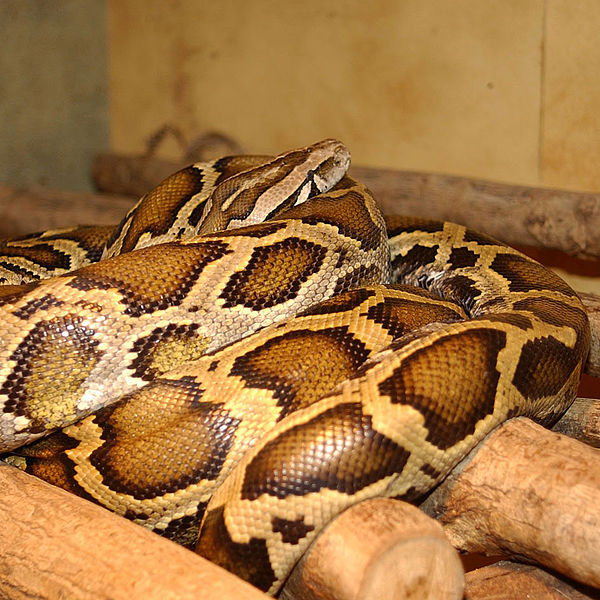
We're being overrun by pythons! It's time to panic! Abandon all hope and emigrate to Canada! At least, that's what USA Today seems to hope that you'll do, based on the tone of the article that they put on the front page of today's paper.
As climate change warms the nation, giant Burmese pythons could colonize one-third of the USA, from San Francisco across the Southwest, Texas and the South and up north along the Virginia coast, according to U.S. Geological Survey maps released Wednesday.

The pythons can be 20 feet long and 250 pounds. They are highly adaptable to new environments. ("Pythons could squeeze lower third of USA" by Elizabeth Weise, p. A1)

Burmese pythons are sold legally as pets in the US, with hatchlings going for as little as $20. Buyers frequently find that dealing with a full-grown python is extremely difficult, and they release the snakes into the wild. There is evidence that these released pets have established breeding colonies in places in the wild, particularly in the Florida Everglades. If you read the story closely, you'll notice that the US Geological Survey isn't exactly predicting that pythons will colonize the lower third of the United States, just that the climate of the lower third of the United States could be hospitable to pythons if the one makes certain assumptions about the increases in temperature that global warning could bring by the year 2100. Now go back and count all of the caveats in that chain.

Today's Shoes

Day

GJ Cleverley bespoke side-elastic shoes with twin-needle stitching on the apron in dark burgundy calfskin with single leather soles.

Evening

Gravati three-eyelet half-brogue bluchers with a modified U-throat in antiqued tan calfskin (Gravati calls it Betis -- it's aniline-dyed calfskin treated with alcohol to strip the finish off partially to make it susceptible to neutral creme, which, when worked in, darkens the leather) with double leather soles with a central rubber plug (16407, 640 last).