Showing posts with label Cary Grant. Show all posts

Wednesday, January 2, 2008

Character


Eighteenth Century Americans had a conception of character very different from our own. Today, we generally regard character as an innate property; but back then, character was something that a person developed. That is, he determined what kind of man he wanted to be, and he played that man as if he were an actor. Eventually, the kind of man he was merged with the man he aspired to be, and he no longer needed to act contrary to nature. That's how Cary Grant viewed character, too. As Benjamin Schwarz writes in the January/February 2007 Atlantic Monthly:
"I pretended to be somebody I wanted to be and I finally became that person. Or he became me. Or we met at some point.” That meeting—when Archie Leach, the Bristol-born son of a part-Jewish suit presser, came to be fully assimilated by his creation, Cary Grant—amounts to one of the great events in the annals of twentieth-century culture. It created what the critic David Thomson (in A Biographical Dictionary of Film, the finest reference book on the movies) flatly declares to be “the best and most important actor in the history of the cinema.” And it’s a joy to watch: although the meeting was years in the making, you can actually see it come to fruition in a single movie, Leo McCarey’s The Awful Truth (1937). Grant’s performance in that film was, in every sense, transformative.

All of us want to become Cary Grant. Even Cary Grant did.

(The rest of the article, which is a nice review of Grant's movie career and of his talent as an actor, is well worth reading, not least for this sentence of pure gold:

He thus transformed his leading ladies “into comic goddesses,” as Kael nicely put it—a feat that was something of a miracle in the case of the cute-’n’-toothy Irene Dunne, or the self-important, inherently humorless Katharine Hepburn.

I don't think that I've ever seen Hepburn so accurately summarized as Schwarz does in just four words. Via Instapundit.)

Monday, November 19, 2007

Monday Evening Movie Review

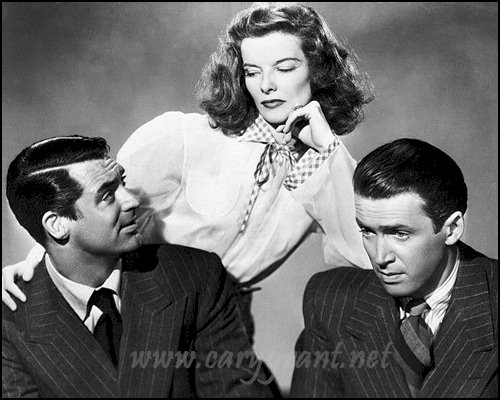
I was flipping channels last night, and I happened upon TMC showing The Philadelphia Story, the famous 1940 comedy starring James Stewart, Cary Grant, and Katherine Hepburn. Hepburn plays Tracy Lord, daughter of the wealthy and socially-prominent Philadelphian Seth Lord. Tracy used to be married CK Dexter Haven, played by Grant, but the marriage dissolved in acrimony and (for Haven) alcoholism. She is now engaged to marry George Kittredge (John Howard), a new man who has worked himself up from coal miner to mine general manager. The problem? Well, there are two problems, really. First is that scandal sheet mogul Sidney Kidd (Henry Daniell) wants pictures of the wedding in his magazine, Spy. Second is that Haven still loves Tracy. Kidd has incriminating information about the philandering of Seth Lord, and he uses this information to blackmail Haven into getting a reporter (and aspiring writer) named Macaulay Connor (James Stewart) and a photographer (and Connor's love interest) named Elizabeth Imbrie (Ruth Hussey) into the Lord house by vouching for them as friends of Tracy's brother, absent in the American embassy in Argentina. As you would expect, hilarity ensues, and everything turns out right in the end.

This is one of my favorite movies. I love Jimmy Stewart and Cary Grant, I love the clothes, and the movie is fun, funny, and entertaining. Of course, it would be impossible to film a movie with The Philadelphia Story's script nowadays. There are just too many, um, questionable lines. Consider the following:
Haven: How about you, Mr. Connor? You drink, don't you -- alcohol, I mean?
Connor: Oh, a little.
Haven: A little? And you a writer? Tsk, tsk, tsk. I thought all writers drank to excess and beat their wives. You know, at one time, I think I secretly wanted to be a writer.
Grant started out in Vaudeville, and he remained a master of comedic timing throughout his career. Stewart is just a fantastic actor, and he won the Oscar for his performance in this movie. It was one of his last movies before he enlisted in the US Army Air Corps, later going on to fly B-17 bombers over Germany in World War II. I'm not a big fan of Katherine Hepburn, but she does a very good impression of aristocratic hauteur in this film. It's not overly deep, and I doubt that it will change your world view. But it is an example of what a good comedy can be. Would that Hollywood would remember what can be done before they turn out more of the same old crap.