

Day
Grenson Masterpieces three-eyelet austerity brogue blucher ankle boots in antiqued British tan calfskin with single leather soles.
Evening
Gravati three-eyelet plain-toe bluchers in navy blue waterproof suede with microcellular rubber soles (15445, 433 last).
Showing posts with label austerity brogue. Show all posts
Showing posts with label austerity brogue. Show all posts
Monday, March 3, 2008


Wednesday, January 23, 2008
Today's Shoes
Day
Grenson Masterpieces three-eyelet blucher ankle austerity brogue boots in antiqued chestnut calfskin with single leather soles.
Evening
Santoni three-eyelet plain-toe blucher ankle boots in dark brown suede reverse welted with a thick rubber lug sole. These shoes were originally purchased to be Manhattan walking shoes. I've bought a lot of these. Walking in Manhattan can be brutal, both because there's so much of it and because the concrete sidewalks provide no cushioning at all. Shoes that don't fit well will cause blisters; and even if they do fit well, they can leave your feet feeling like they've been pounded with hammers. These ankle boots have a thick, cushy, latex rubber sole, and I thought that they would do well in Manhattan. They did okay, I suppose, but the fit in the heel wasn't as good as it needed to be to avoid discomfort after a long day of walking.
Grenson Masterpieces three-eyelet blucher ankle austerity brogue boots in antiqued chestnut calfskin with single leather soles.
Evening
Santoni three-eyelet plain-toe blucher ankle boots in dark brown suede reverse welted with a thick rubber lug sole. These shoes were originally purchased to be Manhattan walking shoes. I've bought a lot of these. Walking in Manhattan can be brutal, both because there's so much of it and because the concrete sidewalks provide no cushioning at all. Shoes that don't fit well will cause blisters; and even if they do fit well, they can leave your feet feeling like they've been pounded with hammers. These ankle boots have a thick, cushy, latex rubber sole, and I thought that they would do well in Manhattan. They did okay, I suppose, but the fit in the heel wasn't as good as it needed to be to avoid discomfort after a long day of walking.
Wednesday, September 26, 2007
Why Are They Called Austerity Brogues?
 In her comment to my post about the shoes I wore on Monday, Mamacita asks:
Have you said before why they are called austerity brogues?
Well, no, I don't think that I have. Here's what Nicholas Antongiavanni has to say about them in his book The Suit:
The "full brogue" has perforations along every seam, from toe to heel. The Americans call it a "wing tip" because the toe decoration, instead of being straight, comes to a point and is said to resemble the wing of a bird. During the Second World War, when tight restrictions were placed on leather usage, English shoemakers offered full brogues without broguing, called "austerity brogues." Their distinctively sleek lines ensured their survival beyond the war, and they remain popular with dandies as an alternative to the plain cap toe. (p. 94)
Mr. Antongiavanni asked me to read and comment on the chapter about shoes in his book before it was published, and I remember that I told him that I didn't buy this explanation. I didn't see how the lack of broguing would save any leather. "Well," he said, "that's the story that I have heard from the London shoemakers." But now that I've thought about it, it really does make sense. If you have broguing on a toe cap or heel counter, you have to back it with finished leather so that the proper color shows at the bottom of the broguing. That means that the toe cap and the heel counter on a standard full brogue must be almost completely underlaid with other pieces of finished leather. Not so on an austerity brogue. The overlap just has to be at the seams. Hence, austerity brogues will use less leather.
(BTW, the shoe pictured is from John Lobb St. James.)

Wednesday, July 25, 2007
Today's Shoes
 Day
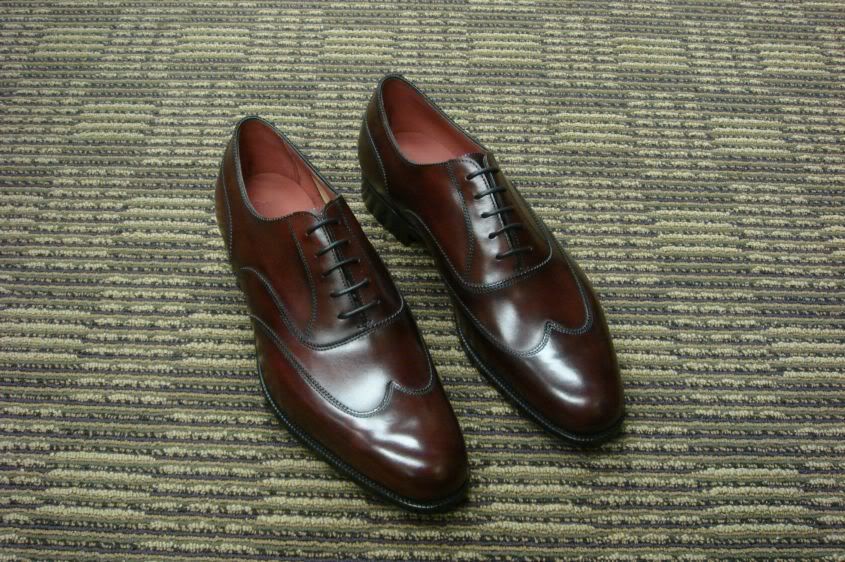
DayEdward Green austerity brogues in antique burgundy calf (Beaulieu model, 888 last). The shoes shown above are identical to my own except that they are on the 82 last instead of the 888. The picture is from LeatherSoul in Hawaii, which is my go-to source for everything Edward Green and Alden. Tom Park, who owns Leather Soul, is a good egg.
Evening
Gravati five-eyelet blucher ankle boot in dark brown peccary with a combination rubber/leather sole (15950, 640 last).
Sunday, June 10, 2007
Today's Shoes
Gravati austerity brogues in larice (chestut brown) Lama (14953, last 640). No, the shoes to the left are not the shoes I'm wearing today, although I do own a pair of them, too. I included the picture to illustrate what an austerity brogue is: a wing-tip bal, only without any of the broguing (punching) that one typically sees on such a shoe. The story is that austerity brogues originated in Great Britain during World War I as a war-time measure to save leather: on a wing-tip with broguing, there has to be a piece of leather underneath the entirety of the wing cap so that the holes and backed by a finished piece of leather and don't look silly. Not so an austerity brogue: the piece of leather comprising the vamp can end just past where it is stitched to the wing cap. How much leather this would have saved, I don't know. I can't imagine that it would have been very much, especially since no self-respecting Briton would have worn a wing-tip in town anyway. The shoes that I'm wearing today comprise my other pair of Goodyear-welted Gravatis. These were a special order, and the only thing that I regret is having them made on the 640 last. Something narrower like the 500 would have been better. Alas.
Subscribe to:
Posts (Atom)
