Showing posts with label Bourbon. Show all posts

Friday, January 25, 2008

Last Night's Tipple

Liquor Claus gave me two bottles of whisk(e)y for Christmas: a Glenfarclas 12 year old, which I wrote about back in December; and a bottle of Eagle Rare Single Barrel 10 year old Bourbon. I hadn't felt like drinking Bourbon until last night, so I hadn't opened the Eagle Rare. Last night I did, though.

Eagle Rare began life in the 1970s as a Wild Turkey knockoff. It was bottled at 101 proof, just like WT; and I suppose that the eagle was supposed to evoke memories about the debate over what the American national bird was to be. Ben Franklin thought it should have been the turkey; but the other founding fathers, in their infinite wisdom, realized that the eagle was a nobler and much more appropriate alternative. Similarly (I conjecture), Bourbon consumers would conclude that Eagle Rare was a nobler alternative to Wild Turkey. Originally a brand owned by Seagram's and distilled at what is now the Four Roses Distillery in Lawrenceburg (the Wild Turkey Distillery is located in the same town). Sazerac acquired the brand in 1989, and it's currently distilled at the Buffalo Trace Distillery in Frankfort.

A few years ago, Sazerac decided to take Eagle Rare up-market. They lowered the proof from 101 to 90, put it in a fancy heavy-bottomed bottle, and made it a single barrel bottling. Oh, yeah -- they raised the price, too. All of these changes were calculated to appeal to the yuppie boutique Bourbon drinker, and they have. Sazerac believes that Eagle Rare will be one of the engines of growth for their Bourbon business in the years to come. Buffalo Trace has three Bourbon mashbills: a wheated one used for WL Weller; a high-rye one used for Ancient Age, Elmer T. Lee, Blanton's, and others; and a low-rye one used for Buffalo Trace, Old Charter, and Eagle Rare. I didn't know that Eagle Rare came from the low-rye mashbill until I looked it up just now, but it's hardly a surprise. The Bourbon was corny. There was very little bite. Instead, it was sweet and smooth. Despite the age, I didn't get a whole lot of overt wood flavor, although it did have a decent amount of vanilla that must have come from the toasting on the barrel staves. My reaction to it is a lot like my reaction to Old Charter: a nice, tasty Bourbon, but not one (like Bulleit or 1792 Ridgemont Reserve) that I could get really enthusiastic about.

Thursday, November 22, 2007

Last Night's Tipple

The last stop on this week's Tour of Wild Turkey is the plain-old flagship 101 proof Bourbon bottling, again. My experience with this whiskey last night was similar to the one I had on Saturday night but better. This time, the whiskey exhibited more the butterscotch aromas that I like in Wild Turkey products and less of the new whiskey, cotton candy smell. It was also not as rough. The difference? Well, aside from the unreliability of the taster, last night I had the ceiling fan going where I did not on Sunday night. More air, different flavors and aromas. I would do well to have the ceiling fan going in the future.

Wednesday, November 21, 2007

Last Night's Tipple

Continuing with this week's Wild Turkey theme, I had another pour of Wild Turkey Rare Breed last night. You will recall that Rare Breed is Wild Turkey's "barrel-proof" bottling, meaning that it is presented as Bourbon that has been bottled straight out of the barrel without any water dilution. Whereas most barrel-proof Bourbons are extremely potent (Booker's is over 125 proof; George T. Stagg is typically over 140 proof), this one is a relatively gentle 108.4 proof, and it is made up of 6 year old, 8 year old, and 12 year old Bourbons. It's true that Wild Turkey enters the barrels at a significantly lower proof than is standard among other Bourbon distillers, but I have my doubts that 108.4 proof (preprinted on the neck band) represents the precise alcoholic strength that the dump making up the batch exits the barrels at.

Regardless, this has consistently been one of my favorite Bourbons because it piles on the unctuous dessert-like flavors and aromas that I like so much. Unfortunately, it wasn't quite so enjoyable this time around. Even after a significant airing, it still smelled woody, and the taste was a bit harsh and unpleasant. Toward the end of the glass, it began to exhibit some buttered popcorn and some butterscotch, like I was accustomed to; but overall, this glass was a bit of a disappointment. Why? I'm not sure, but there are a few possible explanations. First, it could be that nothing whatever has changed in the whiskey or the manner in which I consumed it; that it was my mood and the vagarities of my palate that accounted for the difference in experience. Second, it could be that the manner in which I consumed it differed from the norm and that this difference accounted for the difference in experience. My ceiling fan is typically going while I pour and consume whiskey. Last night, it wasn't. I could certainly believe that that contributed to the quantity and quality of the air the glass got and consequently to the way the whiskey smelled and tasted. Third, it could be that the whiskey is getting oxidized. Yes, oxidized. The bottle has been open for well over a year, and it is getting pretty empty. Spirits don't fall apart from exposure to oxygen the way that most beer and wine do, but eventually they too will oxidize. It could be that that is what's happening with this bottle. Not to worry, though. I'll finish it up soon enough and buy a brand-new one.

Monday, November 19, 2007

Last Night's Tipple

In case you haven't noticed, I'm on something of a Wild Turkey kick recently. Given that this is the week of Thanksgiving, that seems appropriate. Last night, it was another pour of the original 101 proof version of Russell's Reserve. To be honest, it really didn't do a whole lot for me this time. Too much orange, too much wood, not enough cinnamon and caramel. I wonder if ten years is simply too much age for Wild Turkey -- the other expressions that I have tried and enjoyed have been (mostly) younger than that. (Rare Breed does contain some 12 year old juice, but it also contains 6 year old and 8 year old, meaning that the aggregate is likely younger than 10 years old.) It could also be, of course, that this bottle is simply not to my liking or that I was simply not in the mood to enjoy it last night.

Sunday, November 18, 2007

Last Night's Tipple

I write about Van Winkle whiskeys quite a bit, and they deserve to be written about. They've very good. If you look at what I buy and what I drink, you'll find that I buy a lot of Wild Turkey; and for good reason: they make some excellent whiskey, too. But until yesterday, I had never tried the flagship product, the standard 101 proof bottling.

What is now the Wild Turkey Distillery traces its heritage back to the Ripy family, which first distilled whiskey in Anderson County, Kentucky, in 1869. After the repeal of Prohibition, the Ripys revived their distillery. Some of their whiskey was bottled under the label of the Austin Nichols Company, a food and beverage distributer. In 1940, the president of the company, Thomas McCarthy, took some Ripy whiskey that he selected from the warehouse with him on a wild turkey hunt in South Carolina. His fellow hunters liked it so much that they requested him to bring more of that "wild turkey" Bourbon with him the next year. The Wild Turkey brand was introduced in 1942, and the Austin Nichols Company bought the distillery from the Ripys in 1970. Austin Nichols later became part of the Pernod Ricard wine and spirits empire, and Wild Turkey remains an important part of that empire. I would wager that it is the most widely-known of all Bourbon brands after Jim Beam.

In many ways, Wild Turkey was the one of the original modern premium Bourbons; and a premium Bourbon it remains. Whiskey enthusiasts complain incessantly that Jack Daniel's isn't what it used to be and that Jim Beam is watered-down crap. They don't complain about Wild Turkey. It is now what it has always been: big, bold, and unapologetic. Wild Turkey's mashbill is rye-heavy, and they use a #4 char (the heaviest char available) on the barrels that they age their Bourbon in. It's distinctive and delicious in the other bottlings that I have tried. It's younger and wilder, but still delicious in the standard 101 proof bottling. It's very much a young whiskey -- I can't really describe what that means other than to say that there it has fresh, sweet aroma, tastes a bit grainy, and is slightly rough. But it is very tasty. With some time in the glass, it betrays the same cinnamon bread pudding aromas and flavors that I associate with the other Wild Turkey bottlings that I have tried. I like it.

Saturday, November 17, 2007

The Bourbon Country Reader

Chuck Cowdery is a Chicago attorney who has a thing for Bourbon. Not only does he have a thing for it; he writes about it, and well. He is the author of Bourbon, Straight: The Uncut and Unfiltered Story of American Whiskey, an enjoyable compendium of Bourbon history, Bourbon opinion, and Bourbon reviews; the author, director, and producer of "Made and Bottled in Kentucky," a documentary about Bourbon that originally aired on public television; and a freelance contributer to such publications as The Malt Advocate and Whisky Magazine. He also publishes his own newsletter about Bourbon (well, American whiskey, really) called The Bourbon Country Reader. The current edition contains a story about the twists and turns through the years of the Camp Nelson facility (DSP-KY-69), which for many years was a full-blown distillery but currently only has warehouses aging Wild Turkey Bourbon; a mention of the retirement of Jerry Dalton, former master distiller of Jim Beam; a story about the seizure of a million dollars' worth of unlicensed Jack Daniel's whiskey in Tennessee; and a review of the new Russell's Reserve Rye. It's always enjoyable, very readable, and highly recommended.

Last Night's Tipple

Wild Turkey has lots and lots of bottlings. There are the 80 proof and 101 proof Bourbons, the straight rye, Russell's Reserve Bourbon, Russell's Reserve Rye, Rare Breed Bourbon (the barrel-proof offering), and Kentucky Spirit (the single-barrel offering), to say nothing of the one-off bottlings like American Spirit or Tribute. And that's just in the United States. Overseas, one can also get the 101 proof 8 year, the 101 proof 12 year, the 86.8 proof, and Freedom (another barrel-proof offering of age combinations slightly different from Rare Breed). Every variation that I have tried has been good, which of course just makes me want to try more variations. I had been wanting to try Kentucky Spirit for a while, and so I bought a bottle on Friday evening. Mine states on the neck band that it was bottled on May 8, 2007 from barrel number 69 in warehouse E on rick number 13. I have no idea whether anything other than the date of bottling means anything, but there it is. It is bottled at 101 proof, just like WT's most famous and popular bottling. Other things about the packaging, though, are very different. The standard 101 proof bottling comes in an unassuming bottle-shaped bottle, closed with a simple, unassuming, plastic-topped cork. Kentucky Spirit comes in a fancy, flask-shaped bottle with stylized ridges suggesting a fanned-out turkey's tail and is closed with a fancy, carved-wood-topped cork. (I have read that the original Kentucky Spirit bottles actually had corks topped with a pewter turkey figuring). And Kentucky Spirit is expensive, too: more than twice as expensive as a bottle of the standard 101, which itself has a price similar to other premium Bourbons like Maker's Mark.

Is it worth it? Well, that's a question of value that every consumer must consider for himself, but I can say that it is delicious. It has the same spicy sweetness that I have experienced with other WT bottlings (like cinnamon bread pudding, at least to me), although it is distinct from the others. It seems a bit subtler and refined than Rare Breed, which has been my favorite Turkey. After trying Kentucky Spirit, I can't really say whether I prefer it to Rare Breed or the other way around. I imagine that that would depend on mood. And, fortunately, I don't have to choose one or the other: both are plentiful. As a single-barrel offering, one would think that there will be noticeable variation from bottle to bottle. I will be interested to see if that's the case.

Wednesday, November 14, 2007

Last Night's Tipple

I don't know exactly why, but my pour of Elmer T. Lee (which was, of course, not actually from special Sam's bottling) seemed positively light last night. Very pleasant, with loads of vanilla and caramel, but still light. Whether it was the whiskey or my tongue, I can't venture to guess. To be honest, previous tastes of this Bourbon have been pleasant enough, but I have not actively liked it much. Last night, I actually liked it enough that I would buy it again.

Tuesday, November 13, 2007

Last Night's Tipple

Now that I have a back-up bottle of Barton's 1792 Ridgemont Reserve (since Ben found his barely-tasted bottle so odious that he unloaded it on me), I can drink my open bottle freely. Oh, who am I kidding? 1792 Ridgemont Reserve, even though it's positioned as a "small batch Bourbon," is widely-distributed. When you finish a bottle, you just go down to the liquor store and buy more. There's plenty. It's not like the various Van Winkle bottlings, which are usually impossible to find unless you get lucky. I am very grateful to Ben for his gift, though. He might not like this Bourbon, but as I have commented before, I do. As with many others that I have tasted, it benefits greatly from some time in the glass. After a few minutes, it opens up into a wonderful cinnamon-raisin bread pudding aroma. It's delicious.

Tuesday, November 6, 2007

Last Night's Tipple

Another pour of the old-style Wild Turkey Russell's Reserve Bourbon last night. You will recall that in its original configuration, Russell's Reserve, conceived as a tribute for Jimmy Russell, master distiller at Wild Turkey, was 101 proof in an ugly, painted bottle. It's currently bottled at 90 proof and in a much more attractive bottle, but lots of people don't like the reduced proof and are nostalgic for the original. Well, I lucked into the original a few weeks ago. I don't know if it's the increased proof or the Austin Nichols people selecting a different flavor profile, but the 101 proof version is certainly racier and, well, wilder than the 90 proof version. It's not my favorite Bourbon, but it is very good.

Saturday, November 3, 2007

Last Night's Tipple

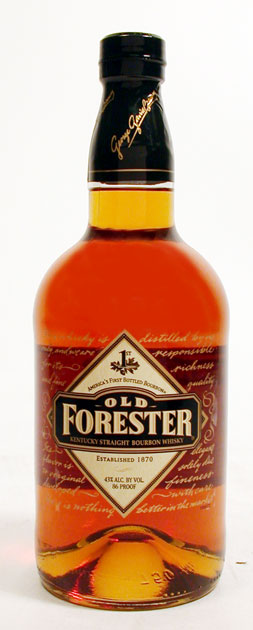
Ben evidently decided that the bottle of Old Forester 86 that he bought and hated was just too vile to remain in his presence any longer, so he brought it with him to Houston this weekend and unloaded it on me. He also gave me a barely-tasted bottle of 1792 Ridgemont Reserve, which he also thinks is execrable. I happen to love that Bourbon, so Ben's taste in spirits is already somewhat suspect in my book. I wanted to determine if he is fully or only partially cracked, though, and so I had a pour of the Old Forester 86.

It's very interesting on the nose: I pick up cocoa, black walnuts, and mushrooms; and the fact that I do is unusual. I'm not one of those tasters who can smell and taste every food product under the sun in a glass of wine or whisk(e)y. Most of what I detect are the elements that hit me over the head. Atomic Fireballs in a rye-heavy Bourbon is about as exotic as I tend to get. In any event, while I could smell cocoa, black walnuts, and mushrooms in the Old Forester, they were muted. It reminded me of a Canadian Whisky in that respect. On the palate, it was a bit green-tasting and thin. I didn't think that it was the best Bourbon that I've ever tasted, but it certainly isn't vile. I think that 100 proof version would be better. Ben is only three quarters cracked.

Friday, November 2, 2007

Last Night's Tipple

Just as more Van Winkle Family Reserve Rye and Pappy Van Winkle 20 year old has recently come on the market in Houston, so too has more Van Winkle Family Reserve Bourbon shown up in the various liquor stores that I frequent. It's about $42 a fifth; and although it's not nearly as rare as the rye or the Pappy 20, it will likely be gone for several months when it sells out. So the obvious question presented itself: should I buy more so that I will have some in the bunker when my current bottle runs out? There is no denying the fact that this is an outstanding Bourbon and one of the finest exemplars of the wheated style of Bourbon available. It's also $42 a fifth. It's just not a good value to me, despite its quality. Had it been the Pappy 15, I would have snapped it up in a heartbeat. That's one of the most sublime spirits that I have ever had, and it's only $3 more a fifth than this. But while this is good, it is certainly not sublime; and I have too much Bourbon to spend that kind of money and use up more space on something that I don't feel strongly about. Anyway, my current bottle is now almost gone, and I really have nothing new to write about the way it tastes.

Wednesday, October 31, 2007

Last Night's Tipple

Bulleit has the highest proportion of rye in its mashbill of any Bourbon currently in production -- something like 33% rye. (AH Hirsch, made at the old Michter's Distillery in Pennsylvania, had more, I think, but it hasn't been produced in more than 20 years.) One of the aromas and flavors that I associate with another high-rye Bourbon, Old Grand-Dad, is cinnamon. Atomic Fireballs, to be exact, most likely from the rye. But I had never gotten that from Bulleit, despite the higher rye content. Well, never until last night. I still got the raisin bread pudding with caramel sauce that I have written about before with this Bourbon, but I also got the Atomic Fireball thing loud and clear. Bourbon never ceases to amaze me.

Tuesday, October 30, 2007

Last Night's Tipple

I cracked open the Pappy Van Winkle's Family Reserve 20 year old that I wrote about on Saturday. As you will recall, Pappy Van Winkle owned the Stitzel-Weller distillery after Prohibition, producing several different brands including Old Fitzgerald and WL Weller, both of which were known for being wheated. Pappy's son sold the distillery in the early 1970s but continued to bottle S-W whiskey under the Van Winkle label. Julian Van Winkle III, Pappy's grandson, continues to do this today. The only problem is that the Stitzel-Weller distillery closed in 1992. So you can do the math: any Van Winkle bottling with an age less than 15 years either contains whiskey older than that or is composed of wheated Bourbon distilled at Buffalo Trace or Heaven Hill's Bernheim. In other words, the 15 year old bottling being released this year is the last 15 year old that will be exclusively S-W juice. That's not a problem with the 20 year old, though -- it can be S-W exclusively for the next 5 years.

The conventional wisdom is that wheated Bourbon benefits more from extreme age than Bourbon made from a standard rye recipe. I don't know if this is universally true -- Sazerac 18 year old rye, which of course has more rye in it than ryed Bourbon, is excellent. Regardless, though, 20 years is a long time for Bourbon. To be honest, I think that it was too long for this Bourbon. The nose is the same delicious caramel creme brulee that the 15 year old version has, but the palate is dry and woody. It's not unpleasant, but I prefer the 15 year old. I'm not disappointed that I spent the money for this bottle since I was intensely curious about it and it's both good and enjoyable; but in the future, if I'm confronted with the choice of a bottle of 15 year old and a bottle of 20 year old, I will take the 15 year old and spend the extra $45 on something nice.

Monday, October 29, 2007

I'm Sorry, Ben

Ben writes:
To add further confusion to the "What Should Ben Drink" topic, I finished a bottle of Weller 12 sometime last week, and on your recommendation, I replaced it with Old Forrester.

Sigh. OF is really harsh and unpleasant.

Sigh indeed. It's becoming increasingly obvious that I haven't a clue about the attributes in a Bourbon that will appeal to Ben. More than that, I should never have recommended Old Forester at all. The only OF expression that I've had is the 2003 Birthday Bourbon; and if I've learned anything from trying many different varieties of Bourbon, it's that different Bourbons made from the same mashbill in the same distillery and aged in the same types of barrels in the same warehouses can taste radically different. The different Birthday Bourbons are intentionally different from one another. It shouldn't be any surprise that they all differ from the OF regular bottlings. More than that, it would not be at all surprising if the two different OF regular bottlings (the 86 proof and the 100 proof) differed in character from one another. It's not necessarily the case that Brown-Forman bottles them like Beam bottles the three different proofs of Old Grand-Dad: dumping a number of barrels, diluting to 114 proof, bottling, diluting to 100 proof, bottling, diluting to 86 proof, and bottling. Brown-Forman may actually be trying for different things with the 86 and the 100 proof expressions of Old Forester.

So the question is, Ben, did you try the 86 or the 100?

Saturday, October 27, 2007

Get It While You Can

I don't know what Van Winkle's release schedule is, but evidently late October is a big time for them. I wrote last week that I had found some Van Winkle Family Reserve Rye at Spec's (only the third time in about eight years that I have ever seen it for sale) and that Spec's also had a small supply of Van Winkle Family Reserve Bourbon. Well, the Richard's on Richmond just west of Chimney Rock got a few bottles of the Van Winkle Family Reserve Bourbon and around 6 bottles of Pappy Van Winkle's Family Reserve 20 year old. In addition to Richard's, I saw the Pappy 20 year at the U P Liquor Store on 43rd at Oak Forest. The Pappy 20 is extremely expensive, and I had not intended to buy any. However, I could not resist. I rationalize my purchase by thinking that it's unlikely that I'll be able to find it again any time soon (the guy at the Richard's told me that he had sold all but one of his bottles in two or three days) and that I deserved a reward for my efforts on the Fall Festival at E&B's school. Yes, those excuses are weak, I know. But that's my story, and I'm sticking to it.

In other rare American whisk(e)y news, Buffalo Trace apparently released the 2007 edition of the Buffalo Trace Antique Collection (George Stagg, Sazerac 18, WL Weller 19, and some others) this week. I have not seen any in Houston, but they are almost surely guaranteed to sell quickly when they do show up.

Friday, October 26, 2007

Last Night's Tipple

I had another pour of WL Weller 12 year old last night, and I got something new and interesting out of it: almond extract. I don't know if my mind was playing tricks on me or what, but smack dab in the middle of the finish was the flavor of almond extract. I am of the opinion that almond extract makes just about everything taste better, so I was pleased.

It's very common to read comparisons between WL Weller 12 and Van Winkle Family Reserve because both are wheated Bourbons, both are 12 years old, both are bottled at similar proof (the Weller at 90 proof, the Van Winkle at 90.4 proof), and both have the same sources (Buffalo Trace- and Bernheim-distilled Bourbon). The Weller can be had for less than $20 a fifth, while the current price on the Van Winkle is around $43 a fifth. The argument is usually that the Weller is a far better value than the Van Winkle. This is almost self-evidently true: the Weller is a good whiskey, and there's no way that the Van Winkle delivers more than twice the enjoyment that the Weller does, at least for me. But I think that most people would agree that the Van Winkle is a superior Bourbon to the Weller, and not by a narrow margin. As with clothing and shoes, you have to pay a lot of money to get relatively small incremental improvements in Bourbon (and whisk(e)y in general).

Thursday, October 25, 2007

Last Night's Tipple

The hook for Wild Turkey Rare Breed is that it's a barrel-proof bottling, meaning that it is not diluted with distilled water between the barrel and the bottle. The stated proof on the bottle is 108.2; and given the fact that Wild Turkey enters the barrel at a lower proof than most other Bourbons, it's plausible that it might exit the barrel after 6, 8, or 12 years (Rare Breed is a mixture of Bourbons of those ages) close to 108.2. What's not plausible is that the proof is printed on the neck band. Austin Nichols wouldn't do that unless they had a whole lot of bottles with the same proof. It's simply not the case that the distillery dumped a barrel of 6 year old, a barrel of 8 year old, and a barrel of 12 year old, blended them together, and bottled the result. They probably dumped hundreds of barrels of each age to do the blend, at which point printing up the labels with the proof statement might have made sense. Of course, I shouldn't be too critical: it's not as if WT claims that this is a small-batch whiskey.

In any event, I like this Bourbon. A lot. You would think that a Bourbon that's 54.1% alcohol would take your head off. This one doesn't. It's smooth, robust, and full-flavored. The distinguishing characteristic of it, as far as I'm concerned, is that it has strong butter overtones. Not butterscotch; butter. It's actually very pleasant. It's a bit like butter pecan ice cream, melted, in a glass. With a hell of a lot of alcohol added.

Wednesday, October 24, 2007

Last Night's Tipple

Another pour of Old Fitzgerald Bottled In Bond last night, and it wasn't particularly enjoyable this time around. It seemed hot and rough, and the Wheat Thin graininess on the finish was annoying. I guess it goes to show that one's impressions of spirits can differ dramatically depending on when one drinks it.

A bit of trivia that I learned this week that may interest nobody other than me: as you may or may not know, all Bourbon currently produced is sour mash, meaning that some of the liquid remaining at the end of the distillation process (called backset) is added to new mash in the fermenters. The standard reasons given for doing this include the desire to ensure consistency and continuity between batches of distiller's beer and to prevent bacterial contamination of the new mash (since the backset is acidic and is consequently inhospitable to bacteria). Anyway, Maker's Mark, like every other Bourbon currently sold, is a sour mash whiskey. They periodically shut down the distillery for cleaning or other reasons, which presents a problem for the first batch of distiller's beer fermented after restarting the distillery after a shut down. Where do they get their backset for these first batches? Why, from Heaven Hill! Which means that your Maker's Mark may have just a little bit of Old Fitzgerald in it.

Tuesday, October 23, 2007

Last Night's Tipple

I've commented on this before, but I get a lot of cinnamon both on the nose and the palate with Old Grand-Dad Bourbon. The first OGD that I tried was the 114 proof version, and I assumed that the cinnamon burn was related to the high proof. But it's present in the 100 proof version, too. It's as if an Atomic Fireball candy has been dissolved in the glass of whiskey. I've had plenty of Bourbon with a proof as high or higher than the OGD 100 proof that I had last night, and I've had Bourbon with a higher rye content (rye is the small grain associated with spiciness, and OGD is known as a high-rye Bourbon; both Bulleit and AH Hirsch have a higher rye content than it, however, and rye whiskeys would naturally have a higher rye content, too), but I've never come across the cinnamon element in any other whiskey. I need to try Basil Hayden's, Beam's upscale version of OGD, at a lower proof and with more age, to see what effect age and proof have on the cinnamon. I suppose I could try the OGD 86 proof version, but that wouldn't be as much fun, would it?