
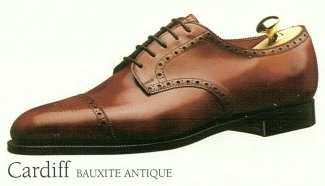
 Edward Green half-brogue bluchers in British antique tan (Cardiff model, 89 last). These are EG-made Ralph Lauren-labeled shoes, purchased for a relative song off of Bluefly. 89 last is a bit unusual. It's big, and it's wide. More than that, though, the vamp of the shoe is high and flat. In some ways, it reminds me of something Hungarian (only on the top of the shoe, though -- the rest is completely different). One of the best, most versatile shoes that Edward Green makes.
Tuesday, July 31, 2007
Today's Shoes
Edward Green half-brogue bluchers in British antique tan (Cardiff model, 89 last). These are EG-made Ralph Lauren-labeled shoes, purchased for a relative song off of Bluefly. 89 last is a bit unusual. It's big, and it's wide. More than that, though, the vamp of the shoe is high and flat. In some ways, it reminds me of something Hungarian (only on the top of the shoe, though -- the rest is completely different). One of the best, most versatile shoes that Edward Green makes.


Last Night's Tipple
 The key to enjoying high-proof spirits, at least for me, is letting them sit in the glass for a while after pouring. Alcohol is volatile, and the act of pouring stirs it up. If you drink it immediately, you'll burn your nasal passages on the volatilized alcohol. If you let it sit in the glass for a while, the alcohol vapor sitting over the liquor will dissipate somewhat, making for a more pleasant drinking experience. I did not use this approach last night while drinking Wild Turkey Rare Breed, and I paid for it. I drank it too soon after pouring it, and it burned my nose and wasn't particularly pleasant. The last few sips were much better and showed the quality that previous tastings of this demonstrated. As I have written before, it's a big Bourbon with a decent rye kick, and I noticed the rye more last night than I have before. It would be interesting to compare this to the single-barrel Kentucky Spirit bottling, which I imagine I will replace this bottle with when it's dead.
Bruichladdich Redux
In response to last night's post about Bruichladdich, commenter The Laddie (and with a username like that, he must be a Bruichladdich enthusiast) writes:
For some strange reason, which turned out to be most fortunate, in the summer of 1998 Bruichladdich was reoppened and distilling recommeneced for a few months under the Jura team management. This stock has been invaluable to the distillery as a stepping stone during that closed period.He's correct, and I was wrong. Andrew Jefford writes in Peat Smoke and Spirit (p. 175):
Between 1994 and 2001, Bruichladdich had only ever worked for six weeks in 1998, when Jim Beam Brands brought the distilling team over from Jura. Interestingly, it was not classic, barely peated Bruichladdich (3 ppm) that was distilled then, but between 100,000 and 120,000 litres of a peaty spirit (at about 38 ppm), which was filled into good casks, including some sherry butts.Some cruising on the Bruichladdich website reveals that some of this 1998 peated spirit made its way into Bruichladdich's 3D bottlings, which combine whiskies of three different peat levels and which have been tremendously successful for the distillery. It would be interesting to taste, both because of the peat level and because some of it was aged in sherry butts. I just can't get my head around what sherried peated malt would taste like -- certainly a mixture of savory and sweet.
Monday, July 30, 2007
Above Average
 At the beginning of Atlantic hurricane season in June, all forecasters that I'm aware of predicted that it would be above average in intensity. It's now halfway through the season, and there has been practically no tropical activity of any sort -- just one tropical storm so far, and that was before the season officially began on June 1. This lack of activity doesn't necessarily mean anything: the second half of the season is more dangerous than the first half, particularly for those of us in the western half of the Gulf of Mexico, because the higher ocean temperatures later in the year are more conducive to storm formation and propagation. Hurricane Katrina made landfall in late August, Hurricane Rita in late September. Still, was there ever any doubt that meteorologists would predict an above average season? There's no glory in being right about a below average or average season, and nobody was ever a goat for being wrong about a doom-and-gloom weather prediction. But imagine the downside if a meteorologist predicted a below average season and a Category 5 hurricane slammed into Florida or Mississippi or Texas. All of the incentives that really matter encourage meteorologists to predict the worst.
Edit: Sure enough, as soon as I post this, we get another tropical storm. It looks like Tropical Storm Chantal is unlikely to strengthen into a hurricane or to threaten any landmass except perhaps Iceland.
Today's Shoes
Day
Gravati cap-toe bals in dark brown deerskin (15441, 500 last). These shoes are unusual in that the seams are both reversed and stitched. Why, I couldn't say. Deerskin is extremely soft, which is reason why it's popular. Unfortunately, it's also prone to scuffs and tearing and stretching, which is why Gravati prefers peccary: peccary has the softness and the look of deer, but it's not fragile. These are probably the best shoe bargain I've ever gotten: $100 new off of eBay. Yes, Brumfield, I realize that every clothing item you've ever purchased put together cost less than $100. In the real world, $100 for these shoes was outstanding.
Evening
Wheeler custom cowboy boots with a square toe and walking heel in dark brown elephant. Since I saw a picture of elephant boots made by Dave Little in San Antonio in The Cowboy Boot Book, I have wanted a pair, and these are them. When I picked them up, Dave Wheeler told me that some of his clients thought that elephant was too durable: they wanted new boots, but they couldn't justify the expense until their old boots wore out; and elephant boots don't wear out.
Gravati cap-toe bals in dark brown deerskin (15441, 500 last). These shoes are unusual in that the seams are both reversed and stitched. Why, I couldn't say. Deerskin is extremely soft, which is reason why it's popular. Unfortunately, it's also prone to scuffs and tearing and stretching, which is why Gravati prefers peccary: peccary has the softness and the look of deer, but it's not fragile. These are probably the best shoe bargain I've ever gotten: $100 new off of eBay. Yes, Brumfield, I realize that every clothing item you've ever purchased put together cost less than $100. In the real world, $100 for these shoes was outstanding.
Evening
Wheeler custom cowboy boots with a square toe and walking heel in dark brown elephant. Since I saw a picture of elephant boots made by Dave Little in San Antonio in The Cowboy Boot Book, I have wanted a pair, and these are them. When I picked them up, Dave Wheeler told me that some of his clients thought that elephant was too durable: they wanted new boots, but they couldn't justify the expense until their old boots wore out; and elephant boots don't wear out.
Last Night's Tipple
 It seems that every other distillery in Scotland has a harrowing story about how it cheated death more than once. Given the great whisky bust of the late 1890s, government-mandated closures during the World Wars, hard times during the Great Depression, and the second great whisky bust of the late 1980s, this is not surprising. Bruichladdich has endured more than its share of hard times, most recently between 1994 and 2001, when Jim Beam Brands decided that the Isle of Jura distillery was more valuable than it and that there wasn't a place in their brand portfolio for both. Given the quality of Bruichladdich's whisky, this seems like a ridiculous miscalculation today.
For its present owners, that seven-year silent period makes things difficult. Whisky is not like beer or wine or vodka or white rum; you can't sell any of it for years after it's produced. This means that the present owners (who, being independent, don't exactly have deep pockets) have to finance present production and aging with the stock that they bought with the distillery in 2001, but that seven year silence before they took over makes selling bread-and-butter 10 and 12 year old bottlings difficult. Do the math. The whisky of those ages is gone and cannot be had again until 2011. Stocks of older whisky still remain, but bottles of Scotch over $50 are a hard sell. Necessity is the mother of invention, and the owners have introduced a number of interesting variations to help keep the money flowing. Among them: Octomore, the peatiest whisky in the world, with the 2003 version clocking in at over 129 ppm of phenols (Laphroaig is typically around 45 ppm), and various non-traditional wood treatments like ex-d'Yquem casks. Their efforts have been remarkably successful, making Bruichladdich the darling of the whisky press and a favorite of Scotch geeks, er, enthusiasts.
As for me, I finished my bottle of 10 year old last night. It is a shame. It's fantastic whisky, elegant, creamy, and malty. Bottles of the 10 year old can still be had, but they're around $50 a fifth now. That's a lot of money, even for a profligate spender like me. And I do like to experiment...
(Incidentally, the comment from Armin in the post about Black Bottle is absolutely correct. There are 8 distilleries on Islay. Kilchoman is a microdistillery that recently started up operation near Bruichladdich on the Rhinns, the western portion of the island.)
Edit: See the followup to this post.
RIP, Marvin Zindler
 Marvin Zindler, the Houston television legend, died yesterday of pancreatic cancer at the age of 85. He was best known for his white wig, blue-tinted glasses, his trademark sign-off from his KTRK stories ("MAAAAAR-VIN ZINDLER, EYE-WITNESS NEWS!"), and his rat an roach report ("There's SLIME in the ice machine!"). He came to prominence in 1973 when he broadcast a series of stories that led to the closing of the Chicken Ranch brothel in La Grange, which served as the basis for The Best Little Whorehouse in Texas musical and later movie. A less-known fact is that he twirled the baton for the Rice University Marching Owl Band back in 1973. I remember seeing Zindler's rat and roach report on the evening news shortly after I came to Houston in 1992 and wondering what kind of place Houston was to have that sort of guy on TV. RIP, Marvin.
Sunday, July 29, 2007
Cliometrics and Basketball
 Tim Donaghy was an NBA referee with 13 years of experience who resigned recently amid allegations that he had bet on basketball games, including games that he had refereed, over the past two years. Apparently, according to the stories, Donaghy is, or was, a compulsive gambler who allowed affiliates of the Gambino crime family to get their hooks into him when he amassed debts to them that he could not pay off; and he bet on basketball games that he officiated as a way to work off what he owed. The clear implication is that he officiated the game in such a way as to maximize the chances that his bets (and the bets of his Gambino friends) would win. The most likely mechanism for this would have been for him to bet that the total score in the game would be over the over/under line, then call more fouls than normal, which would increase the number of free throws in the game and consequently the score. Donaghy is apparently cooperating with the FBI, but the details of his cooperation, as well as his betting strategies and the games that he bet on, are not generally known yet and might never be.
This news is, of course, red meat for the sports press and for sports fans around the country. NBA officiating has long been the subject of widespread criticism. In particular, it has long been an article of faith that the league has forced officials to go easy on superstars and has fiddled with the assignments of referees for playoff games to increase the likelihood that playoff series will be long ones. The news that a referee was apparently corrupt has caused every sports department, sports columnist, and sports blogger searching through the games that that referee officiated for "proof" that he changed the games' outcome. In particular, all of them almost immediately seem to focus on Game 3 of the San Antonio-Phoenix series in this year's Western Conference finals. San Antonio won that game to take a 2-1 lead in the series and went on to win it. During the game and afterwards, Phoenix players, coaches, and fans howled about the officiating. It just so happens that Tim Donaghy was one of the referees. And so now we're treated to bleating from every corner about how the fix was in and Tim Donaghy stole a game for San Antonio that rightfully belonged to Phoenix. Exhibit A of this phenomenon is an ESPN.com column by Bill Simmons:
Before the Donaghy scandal broke, if you told me there was a compromised official working a 2007 playoff game and made me guess the game, I would have selected Game 3 of the Spurs-Suns series. There were some jaw-dropping calls throughout, specifically, the aforementioned Ginobili call and Bowen hacking Nash on a no-call drive that ABC replayed from its basket camera (leading to a technical from D'Antoni). Both times, Mike Breen felt obligated to break the unwritten code that play-by-play announcers -- don't challenge calls and openly questioned what had happened. The whole game was strange. Something seemed off about it.
At the time, I assumed the league had given us another "coincidence" where three subpar refs (and calling that crew "subpar" is being kind) were assigned to a Game 3 in which, for the interest of a long series, everyone was better off having the home team prevail ... just like I anticipated another "coincidence" in which one of the best referees would work Game 4 to give Phoenix a fair shake in a game that, statistically, they were more likely to win. After all, it's easier to win Game 4 on the road than Game 3, when the fans are pumped up and the home team is happy to be home. (Which is exactly how it played out. Steve Javie worked Game 4, a guy who Jeff Van Gundy deemed "the best ref in the league" during the Finals. Hmmmm.) Look, this could have been an elaborate series of connected flukes. I'm just telling you that none of it surprised me. Which is part of the problem.
Bill Simmons's schtick is that he's just a regular old sports fanatic who just happens to get paid to write a column, and you can see all of the attributes of the know-it-all know-nothings that make up so much of sports fandom here in this excerpt. He called it, you see. He knew that the fix was in on Game 3 right from the start, just as he knew that there was no way that the league would let the Suns lose Game 4 after the officiating travesty of Game 3. We won't examine all of the other things that he has known but later turn out to be inaccurate: sports fans love to make prognostications, but they never seem to remember the predictions that didn't come true.
Anyway, the subtext permeating Simmons's column, and the subtext permeating so much of what has been written about Donaghy and Game 3 is this: but for Donaghy's presence on the officiating crew and his corruption, the Suns would have won the game and might have won the series, thus changing NBA history forever! (Whatever happens in sport is always history, you see.) The problem with this is that we can never known what would have happened, and it's largely pointless to contemplate it. If past were not the past, the future would be different; that's all we can say. If Donaghy had not officiated Game 3, something about Game 3 would have been different. How, we can't say.David Hackett Fischer calls the error that sports fans make here the fallacy of fictional questions (Historians' Fallacies: Toward a Logic of Historical Thought, pp. 15-21).
There is nothing necessarily fallacious in fictional constructs, as long as they are properly recognized for what they are and are clearly distinguished from empirical problems... Fictional questions can also be heuristically useful to historians, somewhat in the manner of metaphors and analogies, for the ideas and inferences which they help to suggest. But they prove nothing and can never be proved by an empirical method. All historical "evidence" for what might have happened if Booth had missed the mark is necessarily taken from the world in which he hit it. There is no way to escape this fundamental fact.
If foul trouble had not prevented Amare Stoudamire from playing more than 21 minutes in Game 3, undoubtedly the game would have been different; but it's impossible to determine what the difference might have been. Most people presume that this would have closed the margin between the Spurs and the Suns and made it more likely that the Suns would have won, but this is not necessarily the case. Too often, sports fans and sports columnists will pick out a few calls or coaching decisions that they regard as wrong-headed and concluded that their team would have won but for these bad calls or bad decisions. As Fischer writes in reference to real history, this is a fallacy. We can all agree that it if what has been written about Donaghy is true, it is terrible for the NBA and the game of basketball. Just don't begin to argue that Donaghy's corruption proves that the Spurs didn't deserve to win their series against the Suns.
(Oh, and about Cliometrics. Fischer talks about self-styled Cliometricians, who, at the time that Historians' Fallacies was written, were attempting to apply economic theory to fictional questions. I define Cliometrics as the attempted systemization of fictional questions.)
Today's Shoes
Continuing with the theme from yesterday, Gravati split-toe double monkstrap shoes with twin-needle stitching on the apron and toe seams (which, of course, aren't really seams) in a medium brown super-soft lightly-grained calfskin (16617, 671 last). These shoes are yet another special order, and when they originally came in, they lacked the apron and toe stitching, just about the only time that I can recall the Gravati factory ever making a mistake. Not to worry! Back to the factory they went for the twin-needle stitching, which, remarkably, could be done without the shoe being disassembled. This shoe is a nice companion to my Edward Green double-monk Fulhams, although the Fulham is a chasse while this shoe is a demi-chasse.
Last Night's Tipple
 After my not so favorable impressions of JW Dant Bottled-in-Bond Bourbon a couple of weeks ago, I was eager to see if I would like it any more the second time around. I had another pour of it last night, and I have to say that it did seem better this time. It's grainy with a bit of mintiness on the palate, which I have read is the hallmark of Heaven Hill-distilled Bourbons, and I didn't notice the overt char that impressed me the first time I tried this. It all goes to show you that your perceptions of a whiskey vary greatly depending on factors that I can only imagine: maybe mood and setting, maybe other aromas in the air, maybe even the ambient humidity. I don't know. All I can say is that this tasted like better Bourbon than I remember it being two weeks ago. So take that for whatever it's worth.
Saturday, July 28, 2007
Overheard at the Liquor Store...
 Woman on seeing the price of the bottle of 30 year old Scotch her boyfriend is examining: "Why don't you just buy a bottle of 10 year old Scotch and put it away for 20 years?"
Alas, it doesn't work that way. Spirits, unlike wine, do not age in the bottle. It's the interplay between the spirit, the wood of the barrel, and the air that gets into the barrel that produces the salutary properties that one associates with well-aged liquor. Alternating warm and cool weather forces spirit into and out of the wood of the barrel, which leaches out the vanilla flavors and amber color from the wood (and also the residual sherry, if the barrels happen to be used sherry butts). The oxygen in the air oxidizes the spirit, helping to take some of the edge off of it. (Note that the limited amount of air in an open liquor bottle can also have an oxidizing effect, although a very limited one when compared to the oxidizing effect of the barrel.) So if you want a 30 year old Scotch, you have to pony up the cash to pay for the 30 year old Scotch. Either that, or find a rich friend you can sponge off of.
(And if I were to spring for a bottle of 30 year old Scotch, it probably would be a Macallan, which is known for its talent with older whiskies.)
Today's Shoes
Gravati half-brogue bluchers with an extended welt and a rubber lug sole in dark brown waterproof suede (16407, 640 last). The rubber lug sole and the waterproof suede were appropriate for the rainy weather, although not so much the sand that my lovely goddaughter threw at me at dinner.
Last Night's Tipple
 I was in the mood to try Jack Daniel's Single Barrel again last night, despite the fact that I had had it just last week. It's surprising just how different this is from Bourbon, despite the fact that almost everything about its production is identical to Bourbon production. It's sooty and sweet in a way that Bourbon just isn't. Given just how much of an American straight whiskey is influenced by the barrels that it's aged in, it makes very little sense to me that passing new-make spirit through 20 feet of maple charcoal would make a big difference in the character of the whiskey, but it does.
And yes, this is still very good whiskey.
Friday, July 27, 2007
Today's Shoes
Gravati cap-toe double monkstraps in forest green moon suede with a storm welt and a rubber lug sole (15847, 671 last). Yes, forest green suede. What Gravati calls moon suede is actually a suede with little dots all over the surface, giving it appearance somewhat similar to what sueded peccary would look like. The model is very similar to the John Lobb Paris William model, which is the canonical double monkstrap, and it wouldn't surprise me if Gravati self-consciously was copying William with this shoe. In fact, I have heard that during the period when Wilkes Bashford in San Francisco could not get John Lobb Paris to let them open an account, they knocked off a number of Lobb models with Gravati. Whether this rumor has any truth to it, I can't say; but I can say that just as in the fashion industry, successful shoe designs don't stay exclusive to one manufacturer very long.
Last Night's Tipple
 It can often be a significant challenge to figure out who actually owns a whisky brand (or any spirits brand). The world of spirits has been in almost perpetual flux, and that flux has increased in tempo since the great spirits conglomerates began a wave of consolidation in the 1990s. One would buy another (or two equals would merge) and then sell off some of the brands that overlapped in the united portfolios. Keeping straight who owns what is difficult, especially since corporate parents sometimes like to obfuscate their parentage to give the brand an image as a lonely, small, independent producer. Better romance that way, you see.
And so it was that it took me a good deal of digging to figure out which conglomerate owns Black Bottle, a blended Scotch whisky that has the unique distinction of including whisky from all seven operational Islay malt distilleries. Black Bottle is a venerable Scotch blend, having begun life in Aberdeen in 1879, the property of the three Graham brothers, who had begun their commercial life as tea blenders and merchants. The blend was a success (remember that the late Victorian period was the golden age of Scotch), and the brothers eventually abandoned tea blending and concentrated on Scotch blending. The company remained in Graham family until 1964, when it was sold to Lohn John, another blender. Over the next two and a half decades, the Black Bottle blend fell upon hard times and became a shadow of its former self. It was sold to Allied Distillers in 1990 and began its revival. Here's where the confusion begins. I presume that Allied Distillers was a division of Allied Brewers, which later became Allied Lloyd. Allied Lloyd merged with Domecq in the mid-'90s to form Allied-Domecq, which in turn was bought by Pernod-Ricard in 2005. At the time of the Pernod-Ricard purchase, some of the former Allied-Domecq brands were sold to Fortune Brands and to Diageo. The Black Bottle blend is now owned by Burn Stewart Distillers, which is a division of CL WorldBrands and it is blended and bottled at the Bunnahabhain distillery on Islay, which Burn Stewart also owns. The question is, how did it get there? So far as I can tell, Bunnahabhain was never owned by Allied, Allied-Domecq, Pernod-Ricard, Fortune Brands, or Diageo, and I have never seen mention of Burn Stewart purchasing any brands during this series of acquisitions that I summarized above. So, unfortunately, I am clueless about this.
Black Bottle has two expressions: the regular bottling and the 10 year old version. Both have the claim to fame of being the only blends that have malts from all seven operating Islay distilleries. The standard bottling is 80 proof, and the 10 year old is 86. I have the 10 year old version. It's a testament to just how much peated Islay whiskies can dominate anything that they are blended with. The nose is smoky and peaty, and I swear that I could smell Laphroaig and Lagavulin. It's lighter on the palate than a malt Islay, though, and there is some grain whisky sweetness, too. A very nice dram, especially if you like peated whisky.
Thursday, July 26, 2007
Today's Shoes
Day
Gravati split-toe monskstraps in Radica 03 calfskin with a combination rubber/leather sole (17194, 697 last).
Evening
JM Weston's canonical demi-chasse blucher in dark tan calfskin (Ref. 598).
Gravati split-toe monskstraps in Radica 03 calfskin with a combination rubber/leather sole (17194, 697 last).
Evening
JM Weston's canonical demi-chasse blucher in dark tan calfskin (Ref. 598).
Last Night's Tipple
 Saint Arnold Fancy Lawnmower beer is a Kölsch, meaning that it is a pale beer without as much hop character as a pilsner, top-fermented at a relatively low temperature. It tastes and behaves like a lager, but because it's top-fermented, it technically is an ale. The Kölsch style originated in Cologne, and Cologne remains the city most associated with it.
Saint Arnold's stated goal in developing Fancy Lawnmower was to produce a lighter beer appropriate for consumption during Houston's hot, muggy summers (after, for example, mowing the lawn, hence the name). They have succeeded in doing this. The beer is pleasant, thirst-quenching, and very drinkable. I first tried this beer about three years ago, and I eagerly await its release every spring. I don't buy a ton of beer, but I will buy this when I see it. I don't know whether it would qualify as a perfect example of the Kölsch style or if it's the best exemplar commonly available, and I really don't care. I like it, it's reasonably priced, and I will continue to buy it.
It appears that Saint Arnold has a not-insubstantial hit on their hands with Lawnmower since Shiner has aped them in creating a Kölsch of their own.
Wednesday, July 25, 2007
Today's Shoes
 Day
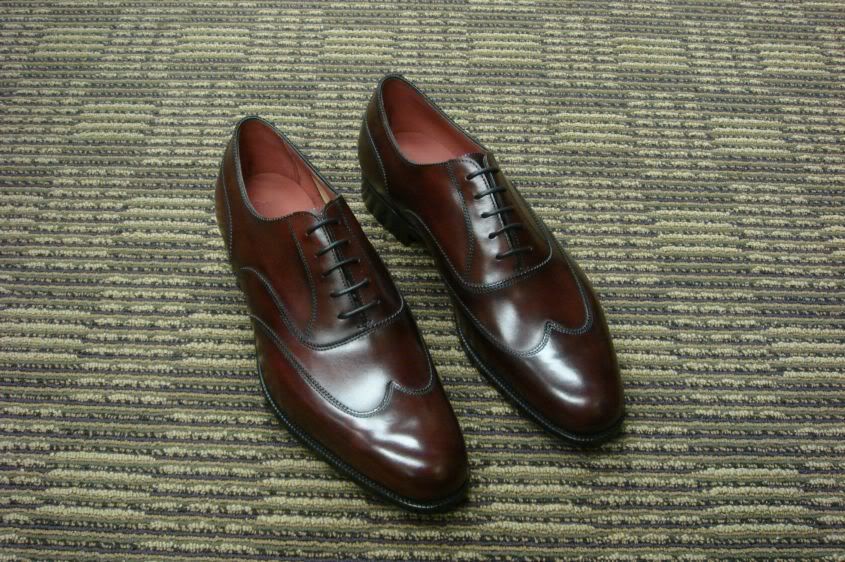
DayEdward Green austerity brogues in antique burgundy calf (Beaulieu model, 888 last). The shoes shown above are identical to my own except that they are on the 82 last instead of the 888. The picture is from LeatherSoul in Hawaii, which is my go-to source for everything Edward Green and Alden. Tom Park, who owns Leather Soul, is a good egg.
Evening
Gravati five-eyelet blucher ankle boot in dark brown peccary with a combination rubber/leather sole (15950, 640 last).
Last Night's Tipple
 I have commented about this before, but Old Grand-Dad 114 really is dominated by cinnamon. It's like someone dissolved an Atomic Fireball in a glass of bourbon. I imagine that the high proof has something to do with this, but it must also be due to OGD's high rye content. Anyway, both this expression and the Bottled-in-Bond expression of OGD have grown on me considerably, and they very well may be th best middle-shelf offerings that Jim Beam has. It was a very enjoyable drink.
Tuesday, July 24, 2007
Almonds!

Do you like almonds? Or, more relevantly, do you like the flavor of almond extract? If you do, check out Blue Bell's Anniversary Cake ice cream. It's almond ice cream with pieces of white cake and a ribbon of almond cream cheese icing and as such is a veritable almond extract extravaganza. It's fantastic and would be perfect in an Amaretto-spiked milkshake.
Today's Shoes
 Day
DayEdward Green double monkstrap shoes with a handsewn apron and toe seam in dark tan calfskin (Fulham model, 82 last). I love these shoes.
Evening
Gravati ghillie-tie bluchers with twin-needle stitching on the apron and toe in tan suede (13555, 500 last). I notice that I wore these shoes last Monday. I apologize profusely for my lack of variety in footwear. I have let you down, and I promise to do better in the future.
Coco Jam
Coco jam, according to FilipinaChef.com, is "is a blend of creamy coconut milk and brown sugar heated to create a wonderful, spread-able fudge that tastes like rich, sweet coconut caramel... sticky coconut Nutella®." Never heard of it before? Neither had I before Mamacita's friend Letitia asked me if I knew of any Filipino grocery stores in Houston. Fortunately for me, Letitia didn't find a Filipino grocery and was curious enough about it to try to make some of the stuff herself. I can't say whether what she made bears much resemblance to honest-to-goodness coco jam of the sort that is sold in the Philippines, but I can say that it is excellent on vanilla ice cream and on toasted English muffins (as an aside, Central Market English muffins are a heck of a lot better than plain old Thomas's). It has the thickness and consistency of honey and tastes like rich coconut caramel. Extremely tasty.
Last Night's Tipple
 I am currently reading Andrew Jefford's book Peat Smoke and Spirit: A Portrait of Islay and Its Whiskies, which is a travelogue cum history cum whisky tasting book of Islay. I have to admit that the chapter in which he describes the terrain of the various regions of the island is not the most interesting thing that I have ever read, but the chapters about the history of the island and its residents and about the seven distilleries still active on Islay are enjoyable.
Ardbeg is the first distillery that Jefford discusses. It lies on the south coast of Islay (along with Laphroaig and Lagavulin), and it dates from 1798. By 1880, it was the most productive distillery on Islay, producing 250,000 gallons of whisky a year. Like most malt distilleries, Ardbeg suffered hard times during the Depression and World War II, closing from 1932-1935 and again from 1939-1945. After the war, the distillery passed between a couple of different owners and was on the verge of closing in 1978 when Allied-Domeq bought it. The problem was that Allied-Domeq also owned Laphroaig and consequently had limited use for Ardbeg whisky -- remember that this was during the period before the emergence of single malts, when all malt whisky was destined for use as blendings; the character that Laphroaig and Ardbeg would bring to a blend are largely similar. The result of this was that Allied-Domeq only ran Ardbeg a few days a year to produce what little they needed, and they allowed the distillery to fall into disrepair. They sold it to Glenmorangie in 1997, and Glenmorangie began a comprehensive (and expensive) program of rehabilitation. Two of the most important of these (at least to the character of the whisky) are the rationalization of the wood aging regime and the standardization of fill levels in the stills. Before Glenmorangie bought Ardbeg, new-make whisky went into whatever barrels happened to be on hand; now, it mostly goes into first-fill or second-fill used Bourbon barrels. Because Allied-Domeq only ran Ardbeg a few days a year, they wanted to maximize their yield for those days and consequently overfilled the stills. This reduces copper contact with the spirit, which in turn makes for a heavier whisky. Glenmorangie reduced the fill level and thus lightened the whisky Ardbeg makes.
Speaking of lightness, that's not a word one usually associates with peated whiskies. But Ardbeg's operation is geared toward producing light whisky. Relatively small fills of the stills has this effect. So does the presence of purifiers on the lyne arms of the spirit stills, the lamp-glass shape of both the wash and spirit stills, and the relatively narrow spirit cuts. All of this increases contact between the spirit and copper, which allows the copper to react to impurities in the spirit and this filter them out. So Ardbeg is something of an anomaly: a lighter, peaty whisky. When you first nose the 10 year old bottling, it's all peat smoke and bacon. That blows off after a little while to reveal a fresh, malty whisky. It was very enjoyable, more so than I remember it.
(Incidentally, my bottle was a gift from Ben and Sara from a few years ago. This means that its contents were distilled during the Allied-Domeq reign; and you can tell it from the extremely pale color of the whisky, which is a result of them using old barrels that had little color left to impart. It will be interesting to try the newer Glenmorangie-made whisky, which should be coming onto the market within the next year or so. This should be more deeply-colored and wood-influenced, lighter, and more peaty due to some innovations that Glenmorangie has brought to mashing that increase the quantity of phenols that make it from the malt to the wash.)
Monday, July 23, 2007
Today's Shoes
 Day
DayCleverley bespoke split-toe bluchers in Russian reindeer calf. It really is amazing how comfortable these shoes are.
Evening
Martegani long-vamp penny loafers in London tan calf (Cortona model).
Last Night's Tipple
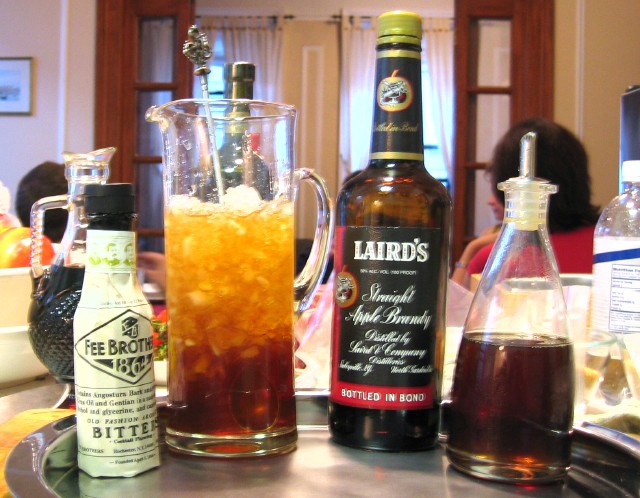 One of the things that I find wondrous about high-quality spirits is that they are chameleon-like: they present different facets of their personalities at different times, depending on the conditions under which they are tasted and the moods of the taster. When I tried Laird's Straight Apple Brandy back in June, I wrote that it tasted like apple whiskey, meaning that it had the same aromas and flavors from its barrel aging that I associate with American whiskey (namely, char and vanilla). When I tasted it last night, the char and the vanilla were still there, but my dominant impression was of fresh apples, with cinnamon and nutmeg in the background. It reminded me of a young Calvados, to be honest, something that I didn't think was possible. It was a totally different experience, but similarly satisfying.
Today's Statistics Lesson
Apparently, the winning number for Texas's Pick 3 lottery game was the same in both Thursday's and Friday's drawing. The three numbers that you pick are between 0 and 9, meaning that the winning number is just a three-digit number between 000 and 999. The fact that the winning numbers were the same on two consecutive days apparently caused some questions, to which Texas Lottery officials replied that the drawings were completely legitimate and that the chances of this happening were 1 in 1000. This is, of course, correct because each drawing is an independent event, there are 1000 possible combinations, and each combination is equally likely. The idiot morning DJ, however, chimed in to say, "Really? I would have thought that the odds are much higher, like 1 in 10,000 or something," once again proving that any moron can get a job in radio.
Sunday, July 22, 2007
Today's Shoes
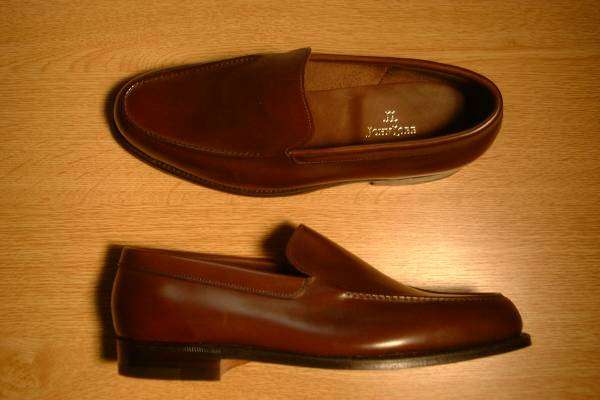 John Lobb unlined Venetian loafers in dark oak calf (Chester model, 6000 last). The shoes pictured above are the same model, but they're in a lighter color than my shoes.
Last Night's Tipple
The way to growth for most large producers of alcohol these days is to sell less volume at higher prices. People around the world are drinking less than they did, but they are buying more expensive alcohol. Most producers have to accept that their case volume will decline year over year, and the only way that they can make up the difference is to sell better stuff more expensively. Not Jack Daniel's, though. Their case volume (8.9 million cases last year) is increasing at 6% a year. When you combine the increasing case volume with the annual price increases that Brown-Forman, the corporate parent of Jack Daniel's, Jack Daniel's practically has a license to print money. It would be difficult to overstate how influential Jack Daniel's is in the world of whiskey. Brands ranging from Jim Beam Black Label to Evan Williams have copied JD's square bottle shape and label style. Boutique offerings like Maker's Mark raise their prices in lockstep with JD's increases. Used JD barrels go all over the world to producers of just about every kind of spirit: Ardbeg, probably the most distinctive Islay malt whisky, ages their whisky almost exclusively in old JD barrels.More than three quarters of that is the standard Old No. 7 Black Label bottling, and most of the remaining is either Green Label No. 7 or Gentleman Jack, which differs from the rest in that it's charcoal filtered twice instead of once. I'm not a big fan of the standard Black Label bottling. It's young, one-dimensional, and has some off-putting flavors. I've never tried Green Label or Gentleman Jack, but my understanding is that Green Label tastes even younger than Black Label and that the Gentleman Jack, what with the double filtration, is even more one-dimensional. Which brings us to the last of Jack Daniel's bottlings: the Single Barrel. As the name suggests, "honey barrels" are dumped and bottled one at a time to make Single Barrel. The whiskey contained in these barrels has been aged between 6 and 8 years, or between 50% and 100% longer than the standard 4 year old JD Black Label. I'm not sure if Master Distiller Jimmy Bedford knows that a whiskey will become Single Barrel when he puts it into the barrel, but I would imagine at the very least that he, like every other competent distiller, knows which areas of which warehouses are likely to produce the quality and flavor profile he's looking for. It's bottled at 94 proof, too, which means that it has more concentration and more of a kick than the Black Label, which is bottled at 80 proof. The bottle that I bought on Saturday was from barrel 6-3094, rick L-34, and was bottled on August 17, 2006. This is largely just marketing fluff because these are utterly meaningless to me and I'm unlikely ever to find another bottle from the same barrel (each barrel produces approximately 240 750 ml bottles). In any event, though, the whiskey inside is very good. It has the distinctive JD smoky sweetness, but there's more vanilla and caramel on the nose. It's lighter than a comparably-aged Bourbon, but that's not necessarily a bad thing. At $35 a fifth, JD Single Barrel is not a bargain, but it's not a rip-off. And I'm glad to be able to say that the largest American whiskey distiller is capable of making excellent whiskey if they want to.
Saturday, July 21, 2007
Tattling
 There is an interesting post up at Parent Hacks about children and tattling:
From Sara:
Kara and her local playground moms sit at a picnic table while the kids play. Around this table they've drawn a circle in the dirt. Why? Well, the circle is the "no tattling zone". Brilliant, isn't it?
It is, for those kids that understand the concept of tattling. Frankly, I find that concept hard to teach. There's a fine line between snitching and coming to an adult for legitimate help. It's a subtle distinction -- too subtle for my kids (and sometimes even me) at this point.
Any thoughts?
Kara's No Tattling Zone makes sense to me. Tattling is not reporting legitimate problems to parents. Rather, it is a mechanism that children use to involve parents as the nuclear bomb to gain an advantage over other children with whom they are having disagreements. Children need to learn the ability to resolve their own disagreements without running to mommy and daddy, and parents who reward their children's tattling are doing them no favors.
There are a number of comments to this post that are very dismaying. Following is a representative sample:I worry that this "don't bother us" method may teach kids that they are failures if they can't solve their own skirmishes or unhappinesses without external guidance or the guidance of adults.Sometimes, I get the feeling that many modern parents are intent on using their children as yet another form of conspicuous consumption. By this, I mean that they attempt to compete with their peers by conspicuously displaying their concern for their children and the seriousness with which they take parenting. When children get older, this can take the form of the parent inserting himself or herself into the child's academic career, arguing over grades with the child's college professors and dictating what courses the child take in college. When the child is younger, it can take the form of refusing to let the child be a child and figure out things about life and dealing with other people by himself. Like I wrote before, parents like these commenters are doing their children no favors.
...
I remember the 'no tattling' rules at school being very isolating - it felt very much as if nobody cared how I felt.
...
Sounds more like a "Don't bother mommy zone" to me. I think that (especially in today's society) kids need to feel free to come to adults for help no matter what the situation is.
Today's Shoes
Gravati split toe bluchers in red-brown Lama calf (16532, 655 last). Interestingly enough, this pattern is identical to that used for my blue suede bluchers except for the apron and toe stitch. This stitching is aesthetic only, not structural, though, so Gravati could just use the exact same pattern and execute the stitching as a sort of post processing. Anyway, like most Gravati shoes, the back seam is reinforced with a strap of leather rather than a dog's ear.
Last Night's Tipple
 As before, Knob Creek really didn't do much for me last night. There's nothing wrong with it, especially, and it's better than many Bourbons that I've tried; but it never succeeds in exciting me. This is unfortunate, given Knob Creek's ubiquity and good price.
Friday, July 20, 2007
Today's Shoes
Gravati plain-toe monkstrap in dark brown peccary with a combination leather/rubber sole (16371, 640 last). Torrential downpours this morning, so a rubber-soled shoe seemed the most prudent option.
Last Night's Tipple
 Another pour of Van Winkle Family Reserve 12 year old Bourbon. My impressions largely match those in June, but I did notice an off-putting pine resin note on some sips. Perhaps it's due to the extensive time in wood.
Scotch is different from Bourbon in many ways, ranging from production methods to marketing and distribution to business practices. The Bourbon business and the Scotch business are both dominated by very large companies now, but the way those large companies operate is significantly different. Scotland has over a hundred operating malt distilleries. Industry consolidation there has largely consisted of multinational spirits companies buying up as many of these distilleries as they possibly can. In contrast, industry consolidation in American whiskey has involved spirits companies buying distilleries and brands and aging whiskey stocks and closing the distilleries. The number of large-scale distilleries producing American whiskey is very small: Jack Daniel's, Jim Beam, Buffalo Trace, and Heaven Hill probably produce well over 50% of the American whiskey on the market; and if you add in Maker's Mark, Wild Turkey, Four Roses, and George Dickel, you likely have over 90%.
The American whiskey and Scotch whisky businesses are both incestuous, but in different ways. American distillers form something of a social club, and they're all more than willing to scratch each other's backs. The master distiller of Heaven Hill is a Beam; and when the Heaven Hill distillery burned in 1996, the Jim Beam Distillery allowed Heaven Hill to distill what they needed on Jim Beam stills. In Scotland, this incestuousness takes the form of each distillery being willing to sell whisky to anybody else, even their competitors. That's why there are many non-distillery bottlings of Scotch and why the various good Scotch blends are so good. There are very few non-distillery bottlings of American whiskey, and what ones there are are likely to become rarer. The modus operandi of American whiskey distillers if they have surplus aging stocks is to come up with a new brand and sell it. There isn't a whole lot of bulk whiskey on the spot market, and it's likely to get rarer in the future. Companies like Kentucky Bourbon Distillers that buy and bottle aging whiskey will find it increasingly difficult to operate successfully.
What does all of this have to do with Van Winkle? Well, it goes to explain the deal that Julian Van Winkle cut with Buffalo Trace in the late '90s whereby Buffalo Trace received the rights to bottle and market Van Winkle whiskeys and Julian Van Winkle received the right to get his pick of Buffalo Trace aging whiskeys for his bottlings. Before this agreement, Van Winkle was an independent bottler (although they did own their own stocks of Stitzel-Weller whiskey). Julian knew that his Stitzel-Weller whiskey was running out and that he would be hard-pressed to ensure that he would able to buy quality whiskey in the future if he remained independent. So he threw in with Buffalo Trace. Given Buffalo Trace's attitude toward distilling and their demonstrated ability to make good whiskey, I have to think that this was a good decision.
Thursday, July 19, 2007
Skunked!
 Central Market carries singleton bottles of beer, and I figured this evening that, in light of the fact that I was too cheap to shell out $8.50 on a six pack, a bottle of Pilsner Urquell would be nice with some chips and salsa. So I bought one. Alas, it was skunked. Skunking is name given to a chemical reaction involving the hops in the beer and catalyzed by light. It's one of the reasons why (good) beer tends to come in dark brown bottles: to prevent light from hitting the beer and skunking it. Not Pilsner Urquell! They preferred a gentle emerald green for their bottles, and condemned me to skunked beer. The bastards!
Today's Shoes
 Day
DayCleverley bespoke three-eyelet plain-toe bluchers in 18th Century Russian Reindeer. The shoes are just beautiful, if I do say so myself. It is mighty stiff, though.
Evening
Gravati austerity brogue bal in a red-brown Lama calf (14953, 640 last).
Last Night's Tipple
 Another pour of The Famous Grouse 12 year old vatted malt whisky, and my reactions to it are much the same as they were back in June. The knock on vatted malts is that the malt distilleries are only willing to turn loose of the sub-par barrels while keeping the good stuff to bottle under their own labels. Aside from the fact that this doesn't sound plausible given that some of the most sought-after malt bottlings are done by non-distillery bottlers like Gordon & McPhail, which wouldn't be possible if the good stuff weren't available, that argument doesn't even add up because the vast majority of whisky produced by every malt distillery, even the huge names like Glenlivet, goes into blends. Malt distilleries could not survive without selling large amounts of whisky off for blending and vatting. In the case of The Famous Grouse vatted malts, another reason to reject this argument is the fact that The Famous Grouse shares the same parent company as the premier flavoring malts that go into the Grouse vatted bottlings: Highland Park and the Macallan. The Edrington Group, the last remaining major Scottish-owned spirits company, owns them all. If they want Grouse vatted malts to have good whisky in them, they will have good whisky in them. And, if the 12 year old bottling is any indication, they do want good whisky in them. This bottle is almost gone; and when it is, I will be buying a bottle of the 18 year old. It is supposedly even better and a heck of a bargain at under $50 for a fifth.
(Incidentally, the Edrington Group also backs JMR Easy Drinking Whisky Company, makers of such bottlings as The Big Spicy One, The Smoky Peaty One, and The Smooth Sweeter One. JMR's stated goal was to demystify and desnobify Scotch and to build up a following for it among younger consumers, most of whom opt for vodka and white rum. I like the idea: despite the renaissance that Scotch has experienced over the past 10 or 15 years, it desperately needs to bring new consumers into the fold if it hopes to avoid the bad times of the '70s and '80s. By all accounts, their whiskies are tasty and well-priced, but they haven't had the success one could hope for. Recently, the brand was withdrawn from the UK market and from certain US cities; and I fear that it will fold up shop completely before too long. That would be a pity. I will have to give a bottle a try before that happens.)
Wednesday, July 18, 2007
Today's Shoes
Day
Gravati three-eyelet wholecut bals in burgundy Lama calf (14391, 683 last). I've been trying to figure out why this three-eyelet wholecut is not as successful as Berluti's iconic club wholecut. Part of it is the fact that I don't wear the Berluti shoe, which means that it's only ever a picture or the equivalent of a piece of sculpture to me; whereas I do wear this Gravati shoe and consequently think of it as an actual piece of footwear. Part of it also is that Lama is so soft that the throat of the shoe does not hold its shape when laced on a foot as well as it would were the shoe made from a stiffer calfskin. But I bet that my shoes are more comfortable than the Berluti model would be.
Evening
Gravati saddle bal in mid-brown peccary with a leather/rubber combination sole (15578, 640 last).
Gravati three-eyelet wholecut bals in burgundy Lama calf (14391, 683 last). I've been trying to figure out why this three-eyelet wholecut is not as successful as Berluti's iconic club wholecut. Part of it is the fact that I don't wear the Berluti shoe, which means that it's only ever a picture or the equivalent of a piece of sculpture to me; whereas I do wear this Gravati shoe and consequently think of it as an actual piece of footwear. Part of it also is that Lama is so soft that the throat of the shoe does not hold its shape when laced on a foot as well as it would were the shoe made from a stiffer calfskin. But I bet that my shoes are more comfortable than the Berluti model would be.
Evening
Gravati saddle bal in mid-brown peccary with a leather/rubber combination sole (15578, 640 last).
Last Night's Tipple
 Another pour of George Dickel Number 12 for me, and this one killed the bottle. My impressions this time were similar to the last time I wrote about Dickel, but I would amplify a couple of things. First is that Dickel, like Jack Daniel's is very sweet. Alcohol can impart sweet flavors by its very nature, and this tendency is accentuated by the caramelization that aging the spirit in charred new oak barrels imparts. But while Bourbon is sweet, Tennessee Whiskey is sweeter, probably because the Lincoln County process (filtering the white dog spirit through twenty feet of maple charcoal before it goes into the barrel) adds even more caramelization on top of what the barrel does. Second, it really is amazing how much better Dickel is after a half hour in the glass than it is freshly poured. With time in the glass, a wonderful vanilla aroma develops that is much, much more appetizing than the unbaked apple pie aroma that it has straight out of the bottle.
Since it won't do to be completely out of Tennessee Whiskey for very long, I will be forced to buy another bottle of either Dickel or Jack Daniels some time soon. This next go around, though, I think that I'll try one of the premium bottlings: either JD Single Barrel or George Dickel Barrel Select. I hear that both are good...
Tuesday, July 17, 2007
Of Barley, Malt, and Peat
 The marketing materials produced for spirits companies commonly appeal to tradition. Our Scotch must be good, the implicit (or explicit) message is, because our master distiller has inherited hundreds of years of knowledge from many, many generations of master distillers. We've been making whisky in exactly this way since God was a boy. Well, it's all a bunch of bull. You wouldn't want to drink what Scotch distillers made in 1800: it would be harsh, unaged, and full of headache-inducing congeners and non-ethanol alcohols. Everything about it, except the site of distillation and possibly the water used for it, would have been different, including the type and size of the stills, the varieties of the barley, the way the barley was malted, the way it was dried, and the types of barrels used. Distillers constantly tinker with everything about their process in an attempt to improve the taste of the whisky they produce, to make the process more efficient, or both.
Take barley, for example. No modern distiller could stay in business using the varieties of barley that were common in Scotland in the 19th century. There simply wasn't enough starch in those barleys to convert into alcohol in an efficient manner today. For time immemorial, man has genetically engineered the crops he plants, but the pace of genetic engineering barley (and many other crops, of course) accelerated dramatically in the 20th Century with the advent of academics and industry-funded institutes whose purpose in life was to make barley better -- more weather- and insect-resistant, higher in starch, higher in potential alcohol, and whatnot. The first barley variety to take Scottish agriculture by storm was Golden Promise, which was developed in the 1960s and withing a few years accounted for more than 90% of barley plantings in Scotland. By the mid '80s, though, it had been superceded by other varieties. Currently, the most prevalent barley variety is named Optic, although it will undoubtedly be made obsolete by something better within a few years. Some "tradition-minded" distillers still use older barley varieties, but the likelihood of those varieties being older than Golden Promise is vanishingly small.
Yeast plus starch equals not much. Yeast plus sugar equals alcohol. Grain has lots of starch and little sugar. Converting that starch to sugar is essential for producing something that can be fermented, which can then be distilled. For Scotch, that conversion is accomplished by malting the barley. This means steeping the barley in water to cause it to germinate, which releases enzymes that convert the starch in the barley to sugar. After germination, the process has to be stopped to keep the barley grains from growing into new barley plants. Not only that, but the malted barley has to be dried to prevent it from rotting. This is done by heating the malted barley in a kiln. Traditionally in Scotland, this was done in kilns fired by burning peat. Now, it mostly is done by coal- or gas-fired kilns. It used to be that each distillery would do its own maltings. This is now rare -- most malt today is now bought from one of the huge commercial malters like Port Ellen.
Peat-dried malted barley gives a distinctive smoky aroma and flavor to some Scotches, most famously those from Islay. The peatiness of a whisky is measured by the parts per million of phenols it contains (I have been unable to find out exactly how the ppm of phenols is measured or whether it is measured in the malted barley or in the finished spirit). Ardbeg, generally acknowledged to be the peatiest of the widely-released Scotches, has around 50 ppm of phenols. Laphroaig has 40 ppm, and Caol and Bowmore have around 35. Not all of the phenols come from the barley -- because water on Islay filters through peat bogs there, whisky made from unpeated barley but Islay water will still have 2 ppm of phenols. It is possible to make something much peatier than Ardbeg, and in fact Bruichladdich has -- an experimental bottling that contains 167 ppm of phenols. I also don't know how this is achieved: do they smoke the barley longer, or do they use a higher proportion of peat-smoked barley? And do the peated malts of today use a certain percentage of peated barley and a certain percentage of unpeated barley? Hopefully I will be able to figure this out soon. Stay tuned...
Today's Shoes
Day
Gravati punch cap high-lace balmoral ankle boots in dark brown calf (10278, 683 last). A person can't have too many high-lace boots, I say. I was considering today whether it would be a good idea to have this pattern made up with a wing cap instead of a straight cap, and I concluded that it was not. A plain toe would work, however.
Evening
John Lobb Paris split-toe penny loafer in dark brown pebble grain calf (Campus model, 3198 last).
Gravati punch cap high-lace balmoral ankle boots in dark brown calf (10278, 683 last). A person can't have too many high-lace boots, I say. I was considering today whether it would be a good idea to have this pattern made up with a wing cap instead of a straight cap, and I concluded that it was not. A plain toe would work, however.
Evening
John Lobb Paris split-toe penny loafer in dark brown pebble grain calf (Campus model, 3198 last).
Last Night's Tipple
 I have nothing much new to add to my previous writeup of Wild Turkey Russell's Reserve other than to say that I am rethinking my opinion expressed therein about lowering the proof of this Bourbon from 101 to 90 not being a bad thing. The fact of the matter is that Bourbon does not come out of the barrel at 90 or 101 proof, meaning that it has to be watered down to reach that level. What I like most about Bourbon are the vanilla, caramel, and butterscotch aromas and flavors that come from the barrel; and it stands to reason that adding water to what comes out of the barrel reduces the concentration of those things. It is true that the reduced alcohol tends less to deaden one's taste buds, but perhaps the trade-off isn't worth it. Maybe if I had a bottle of the 101 proof RR, I could compare and arrive at a definitive conclusion; but, alas, I can't.
Monday, July 16, 2007
Today's Shoes
 Day
DayEdward Green plain-toe side-buckle monkstraps in Edwardian Antique (Stowe model, 808 last). Stowe is Edward Green's answer to John Lobb Paris's sublime Jermyn II, the difference being that Jermyn II is a wholecut where Stowe has separate pieces of leather for the vamp and quarters. In recent years, Edward Green has retired this model in favor of the Oundle, which has less sweep in the strap, because the configuration of the strap and the vamp/quarter seam in the Stowe is not particularly comfortable or particularly durable. My Stowes were a special order from Edward Green's Burlington Arcade store (before they shut down that store and moved to the current one on Jermyn St.).
Evening
Gravati split-toe ghillie-tie bluchers in tan suede with a rubber sole (13555, 500 last).
Limoncello
 Problem: a lemon-flavored liqueur is perfect in a large number of summertime drinks, but the limoncellos available in the United States are sickly sweet and as often as not have such high doses of artificial yellow coloring that they almost look radioactive. Solution: make your own limoncello. It is true that Sorrento lemons, which are typically used for limoncello in southern Italy and are usually regarded as the perfect fruit for the purpose, aren't generally available over here; but common Eureka lemons can do just fine. Here's the recipe:
- Zest a dozen good-sized lemons. Don't get any of the pith.
- Immerse the zest in a fifth of 100 proof vodka. Seal in an air-tight container.
- Wait a few weeks.
- Strain the liquor (which should now be bright yellow) off of the zest (which should now be white).
- Add another fifth of vodka.
- Add simple syrup (50-50 mixture of water and sugar) to taste. I think that I added around 2 or 3 cups.
- Let the mixture marry for another few weeks.
- Enjoy, and make fun of those who claim that the liqueur is too strong.
Last Night's Tipple
 I had Barton's 1792 Ridgemont Reserve Bourbon again last night, and my impressions were much the same as when I had it back in May. If anything, I liked it better: it's thick and dark and very flavorful, and it's an excellent buy for $25 a fifth. I have read a number of reviews that criticize this whiskey as being thin, flavorless, odorless, and alcoholic; and for the life of me, I don't know how the reviewers can be tasting the same Bourbon I am.
Barton Brands is not a big name in the Bourbon business. It owns a number of brands (Ten High, Tom Moore, etc.), but the only one before the advent of Ridgemont Reserve that had any degree of prestige was Very Old Barton. This has quite a good reputation, but it is distributed only very spottily outside of Kentucky. Most other distilleries, if they wanted to create a new brand of premium Bourbon, would have selected the "honey" barrels of their main brand because doing so would reduce the amount of time between the decision to launch the brand and the brand's actual lauch. Not Barton. Barton decided to create Ridgemont Reserve from the ground up, developing a new mashbill for it significantly different from the one used for Very Old Barton. Not only that, but they decided to change the mashbill not by doing anything traditional like substituting wheat for rye or increasing the rye content. They decided to jack up the percentage of malted barley used. Typically, the malt percentage in Bourbon and rye mashbills is very low, and the malt is only used for the enzymes it contains that convert the starch in the other, unmalted grains into sugars so that the yeast will have something to ferment. Barton is the only Bourbon distillery that uses it as a flavoring grain. I can't honestly claim to be able to taste the malt in Ridgemont Reserve, but I can say that Ridgemont Reserve is different from other Bourbons that I have tried.
Sunday, July 15, 2007
Today's Shoes
Gravati plain-toe wholecut blucher with reversed seams on the eyelet facings in a caramel tan calf with a rubber lug sole. It rained this morning, it was Big E's 6th birthday, and I had the feeling that I would either be running around getting stuff for the party or be in the muddy back yard or both.
Last Night's Tipple
In the early days of Kentucky Bourbon, not everyone who wanted to distill had enough wherewithal to afford a copper pot still. It was common in such circumstances to improvise a pot-like still from a log. That's right. A log. A log was split in half, hollowed out, and joined back together. The top was fitted with a thing that looked like a hollow Hershey's Kiss with a copper pipe running out of it. Another length of copper pipe ran through the hollowed-out portion of the log. The distiller would fill the cavity of the log with his beer, run steam through the copper pipe in the cavity, and collect the alcohol running out of the copper pipe coming out of the Hershey's Kiss on top. This method of distilling was called "running the log," and one of the early distillers who used it was Joseph Washington Dant, who began distilling in Nelson County in 1836. The Dants became one of the first families of Bourbon, with JW's eponymous brand of Bourbon and son Joseph Bernard Dant's Yellowstone Bourbon being two of the best-selling Bourbon brands in their day. Just as you can't turn around today without meeting another Beam in Nelson County, so too do Dants abound, although they have been out of the whiskey business since shortly after Prohibition. The JW Dant brand kicked around a number of different owners and finally settled with Heaven Hill in the 1980s. It's not a prestige brand anymore, and its distribution is limited; but it does have a modest following.The bottle of JW Dant that I bought was Bottled in Bond. The back label says that it was distilled and bottled at DSP-KY-31. The interesting thing about this is that DSP-KY-31 is the old Heaven Hill Distillery, which burned in October, 1996 and has not been rebuilt. The bottom of the bottle has the digits "06," which suggests that it was bottled in 2006. This means that the whiskey in the bottle is either 10 years old, or Heaven Hill is using old labels. After tasting the whiskey, I think that the latter explanation is more likely. The nose is all char and wood, developing into vanilla with some time in the glass. The palate is grainy and hot. This does not taste like an old whiskey, and I would be absolutely shocked if it was actually distilled in 1996. It's not spectacular, but it is a decent enough whiskey for $15 a fifth.
Saturday, July 14, 2007
The Crack Sandwich
Today, I sampled some of Mamacita's Crack Sandwich at the Stone Mill Bakers at Westheimer and Kirby. It's sliced turkey and cantaloupe with lettuce and mayonnaise on jalapeño corn bread (kind of a misnomer because while it does have corn it it, it has neither the texture nor the flavor of corn bread), and it's very good. I wouldn't go so far as to say that it's addictive, but it was better than my BLT on jalapeño corn bread. This is all the more surprising because I don't like either cantaloupe or mayonnaise, and I don't have much use for sliced turkey.
Today's Shoes
Gravati wingtip bals in walnut waterproof suede (15902, 640 last). These are another Gravati special order, one of the first ones that I did. The idea for these shoes came from a pair of fawn suede Ferragamo Tramezzas that came out a few years ago. I liked the shoes but wanted something with my own stamp. The color of suede that I selected was a bit darker and a heck of a lot oranger, and I made it more of a casual shoe than the Ferragamo shoe that was its model. It has natural-colored Rapid stitching along the sole edges and matching natural laces, and it has a relatively extended double sole (along with extended heels). The sole and heel treatments are identical to the tan Gravati 16407s that I have. Had I to do over again, I would have selected a last a little less clunky than the 640. Oh, well. Them's the breaks.
Shortly after I got these shoes, I was wearing them while working on a Saturday afternoon. I had a carton of greasy hot and sour soup on my desk, which I promptly knocked off and spilled all over my new shoes. I was scared to death that I had just ruined my brand new shoes, but they cleaned up just fine with some white vinegar and water. You can't tell today that any greasy pseudo-Chinese soup ever spilled all over them, a testament to just how resilient the waterproof suede Gravati uses is.
Shortly after I got these shoes, I was wearing them while working on a Saturday afternoon. I had a carton of greasy hot and sour soup on my desk, which I promptly knocked off and spilled all over my new shoes. I was scared to death that I had just ruined my brand new shoes, but they cleaned up just fine with some white vinegar and water. You can't tell today that any greasy pseudo-Chinese soup ever spilled all over them, a testament to just how resilient the waterproof suede Gravati uses is.
Last Night's Tipple
 I had a hankering for Old Grand-Dad, so I had a pour of it last night. Nothing new to report: notes are similar to when I first had it back in June.
Friday, July 13, 2007
Today's Shoes
 Alden two-eyelet reverse-welted chukka boots in polo suede with a leather/rubber commando sole (Barrie last). The picture shown to the right illustrates the Alden model that these boots were made with, but mine are lined and made in a beautiful medium red-brown suede instead of that ghastly light tan desert-boot-type stuff. They were a special order from Alan White at the Alden Shop in San Francisco. Alas, Alden no longer does one-off special orders, or I would have more shoes in polo suede.
Last Night's Tipple
 Bulleit Bourbon again because I was posting something on Ask Andy about Four Roses Distillery (which distills Bulleit by contract for Diageo), and this put me in the mood to write it. I can't improve on what I wrote about this last month, so I'll just say that Bulleit is an enjoyable Bourbon despite the marketing crap that Diageo spews about it and lament that Four Roses Bourbons are not available in Texas yet.
Buffalo Trace Mashbills
Ben comments in my post about Buffalo Trace Bourbon:
I will not address whether Ben's preference for Knob Creek over Buffalo Trace proves that he is a philistine.
Bought a bottle of this a few days ago. Do you know what's in the mashbill? The heat and spice make me think it must have a high proportion of rye.According to what I have read online, Buffalo Trace Distillery has four different mashbills: the rye whiskey mashbill used to make Sazerac Rye; the wheat mashbill used to make wheated Bourbons like WL Weller; the low rye mashbill used to make Bourbons such as Old Charter, Eagle Rare, and Buffalo Trace; and the high rye mashbill used to make Bourbons such as Ancient Age, Elmer T. Lee, and Blantons. See here, although I have seen and cannot now find something more comprehensive before. I don't know the exact proportions of each mashbill, but I have read (from Chuck Cowdery, author of Bourbon Straight: The Uncut and Unfiltered Story of American Whiskey and a noted authority about Bourbon, Rye, and other straight American whiskeys) that Old Charter's mashbill (ie, the Buffalo Trace low rye mashbill, which is also used for Buffalo Trace Bourbon) is more than 80% corn.
At any rate, I don't much care for it compared to Knob Creek, but at $15 I certainly wasn't ripped off.
I will not address whether Ben's preference for Knob Creek over Buffalo Trace proves that he is a philistine.
Thursday, July 12, 2007
And in Whole Foods News...
 Things just get curiouser and curiouser in Whole Foods' attempted acquisition of Whole Oats and the FTC's lawsuit to prevent it. The Wall Street Journal has a front-page article about posts that Whole Foods CEO John Mackey made on the Yahoo message board for Whole Foods' stock ("Whole Foods is Hot, Wild Oats a Dud -- So Said 'Rahodeb'", p. A1). This would be strange and probably unwise if he had done it under his own name, but what can you say about him doing it with a pseudonym? How about the fact that he trashed Wild Oats repeatedly and talked up Whole Foods?
In January 2005, someone using the name "Rahodeb" went online to a Yahoo stock-market forum and posted this opinion: No company would want to buy Wild Oats Markets Inc., a natural-foods grocer, at its price then of about $8 a share."Would Whole Foods buy OATS?" Rahodeb asked, using Wild Oats' stock symbol. "Almost surely not at current prices. What would they gain? OATS locations are too small." Rahodeb speculated that Wild Oats eventually would be sold after sliding into bankruptcy or when its stock fell below $5. A month later, Rahodeb wrote that Wild Oats management "clearly doesn't know what it is doing .... OATS has no value and no future."
This is so bizarre that I can't think of anything better to say about it than Harvey Pitt, former chairman of the SEC, did in a quote in this article:
For an executive to use a pseudonym to praise his company and stock "isn't per se unlawful, but it's dicey," said Harvey Pitt, a former Securities and Exchange Commission chairman. Told of the Mackey posts, Mr. Pitt said, "It's clear that he is trying to influence people's views and the stock price, and if anything is inaccurate or selectively disclosed he would indeed be violating the law." He added that "at a minimum, it's bizarre and ill-advised, even if it isn't illegal."
Today's Shoes
Day
Gravati plain-toe side-elastics in burgundy (055) Radica calf (16624, 683 last). Have I mentioned recently how useful side-elastic shoes are?
Evening
Ferragamo wing-tip bluchers in cognac calf. These shoes are about five years ago, and I would be surprised if I've worn them in the last three. They epitomize both what is good and what is not good about Ferragamo. On the good side of the equation is the sleek round toe, the color of the calfskin, and the unusual sunburst medallion design. On the bad side is that, attractive though the last may be, it doesn't have good fit characteristics: it's too long, it's too full in the forefoot, and the heels are too wide. At least for me. In addition, they're not made as well as they should be for shoes that were as expensive as these were. Of course, once the shoes are in one's closet, it doesn't matter what one paid for them. It only matters whether one gets good use out of them. Unfortunately, I haven't gotten very good use out of them.
Gravati plain-toe side-elastics in burgundy (055) Radica calf (16624, 683 last). Have I mentioned recently how useful side-elastic shoes are?
Evening
Ferragamo wing-tip bluchers in cognac calf. These shoes are about five years ago, and I would be surprised if I've worn them in the last three. They epitomize both what is good and what is not good about Ferragamo. On the good side of the equation is the sleek round toe, the color of the calfskin, and the unusual sunburst medallion design. On the bad side is that, attractive though the last may be, it doesn't have good fit characteristics: it's too long, it's too full in the forefoot, and the heels are too wide. At least for me. In addition, they're not made as well as they should be for shoes that were as expensive as these were. Of course, once the shoes are in one's closet, it doesn't matter what one paid for them. It only matters whether one gets good use out of them. Unfortunately, I haven't gotten very good use out of them.
Last Night's Tipple
 It's not uncommon for Speyside Scotches to be referred to as "feminine," usually when in the next sentence the writer refers to an Islay Scotch as "masculine." I'm not sure what this means except that Speysides typically don't have an aroma that explodes out of the bottle and hammers the drinker over the head. This is not to say that Speysides cannot be extremely aromatic and flavorful. Macallan is one such, and Cragganmore is another one.
Cragganmore is another distillery that was part of the Great Scotch Explosion of the second half of the 19th Century, having been founded in 1869 by John Smith. Mr. Smith is known largely because of the strange design that he arrived at for Cragganmore's spirit stills (Scotch is typically distilled twice, once in a larger wash still and a second time in a smaller spirit still). He made them small and narrow, with a flat top and a lyne arm exiting the still at a right angle to the neck. His goal in making his stills this way was to produce a relatively light and aromatic spirit, and he succeeded. Cragganmore claims on its neckband that it is "an elegant sophisticated Speyside with the most complex aroma of any malt... astonishingly fragrant with sweetish notes and a smokey maltiness on the finish," and Diageo, on its Classic Malts website, quotes spirits author Michael Jackson as saying that Cragganmore is "[t]he most fragrant of whiskies." It's not all marketing hype. I don't know about it being "the most fragrant of whiskies," but it has a powerful honeyed nose with hints of thyme. The palate is very malty, with some grassiness on the finish. This is one of my favorite Scotches: fragrant, appetizing, and drinkable.
Rant of the Day
Memo to Morning Radio DJs
The fact that the weather forecast calls for the day to be sunny with a low chance of rain is not a necessary and sufficient condition to label the weather for the day as "perfect". When, for example, the predicted high temperature is 98 degrees and the humidity is high enough for the dew point to be in the mid-70s, the vast majority of the American population would consider the weather as being far from perfect, even if there isn't a cloud in the sky and the chance of thunderstorms is 10%.
The fact that the weather forecast calls for the day to be sunny with a low chance of rain is not a necessary and sufficient condition to label the weather for the day as "perfect". When, for example, the predicted high temperature is 98 degrees and the humidity is high enough for the dew point to be in the mid-70s, the vast majority of the American population would consider the weather as being far from perfect, even if there isn't a cloud in the sky and the chance of thunderstorms is 10%.
Wednesday, July 11, 2007
Today's Shoes
 Day
DayEdward Green bespoke bals in dark brown calf. The dominant feature of these shoes is that the U-throat, the diamond-cap, and the counter are all done with the pie crust-style hand-sewing that typifies the Edward Green Dover. Edward Green's bespoke program is now defunct since their lastmaker, Tony Gaziano, left to found Gaziano & Girling with Dean Girling, who is one of the best bespoke makers around. Tony designed these shoes based on an idea of mine, Tony made the last for them, and Dean made them. After they want out on their own, Tony asked permission to photograph them with G&G trees for display on the G&G website; and I readily agreed. He liked the design well enough that a rendition of it called the Gable is included in his RTW line.
I'm really proud of this design. It all started with a Sutor Mantellassi shoe that I saw a picture of. The shoe was a wholecut with twin-needle stitching forming a standard cap-toe design. I thought that it would look good with a wing-cap and a U throat, and I asked if Gravati could do it. They said that they could not. I asked Ron Rider if Martegani could do it. He said yes, and a few months later I got my hot little hands on the finished shoes. I liked the result so much that I decided to get a bespoke rendition of it. One of Tony's design signatures is the diamond tip, so I decided to replace the wing-cap with a diamond-cap. I also thought that the Dover-style pie crust-style would be more elegant. I think the results are spectacular. But I'm hardly objective.
Evening
John Lobb Paris Venetian loafers in dark brown calf (Chester model, 6000 last).
Last Night's Tipple
 Vatting lesson #1: Islay dominates anything it touches. That's what I learned from vatting Clynelish and Caol Ila 50-50 last night. The result smelled like Caol Ila, and it tasted like Caol Ila. I really couldn't detect any of the Clynelish in the blend, even though Clynelish is hardly an unassertive malt. My purpose in doing this was to see how the vatting compares to Compass Box Eleuthera, and the clear answer is that Eleuthera was both better and more complex. With Eleuthera, one could pick up elements from both Clynelish and Caol Ila. With my vatting, I could not. The moral of the story, I think, is that if you want to combine a Highlands Scotch and an Islay one and get elements from both, you need a lot more of the Highlands Scotch than of the Islay. Perhaps I will repeat the experiment with a 75-25 ratio.
Tuesday, July 10, 2007
Today's Shoes
Day
Gravati cap-toe bal in mid-brown Lama calf (16592 , 500 last). I really need to get this shoe in dark brown Lama, too. The informality of the grained calfskin contrasts nicely with the formality of the shoe style.
Evening
Gravati plain-toe monkstrap in dark brown peccary (16371 , 640 last).
Gravati cap-toe bal in mid-brown Lama calf (16592 , 500 last). I really need to get this shoe in dark brown Lama, too. The informality of the grained calfskin contrasts nicely with the formality of the shoe style.
Evening
Gravati plain-toe monkstrap in dark brown peccary (16371 , 640 last).
Last Night's Tipple
 I regret to inform you, the faithful readers of The Last Shall Be First, that I am a good-for-nothing layabout and have consequently not attempted by Caol Ila-Clynelish vatting experiment yet. I have nothing to offer in my own defense except the fact that I felt like having a Bourbon last night. Buffalo Trace's Elmer T. Lee fit the bill nicely. I have nothing to add to what I wrote about this whiskey before, but it was very pleasant.
Monday, July 9, 2007
A Pillow Bleg
 For those of you who are side-sleepers, have you ever tried one of those hourglass-shaped neck pillows like the ones pictured to the left? If so, do they work? And does anybody have a recommendation for something else to avoid getting a neck crick during the night? Thanks in advance...
Yes, Virginia, Japan's a Bit Different From Here
 Lexus is a fantastically successful luxury car brand in the United States, but Toyota (which owns Lexus) is having a difficult time establishing it in Japan. It was only introduced there in 2005, and, according to a front-page article in today's Wall Street Journal ("The Samurai Sell: Lexus Dealers Bow to Move Swank Cars", p. A1 -- yes, I know that half of the moderately interesting things that I write about come from articles in the Journal; my existence is circumscribed), it's struggling to get traction. BMW and Mercedes-Benz have a stranglehold on the Japanese luxury car market, and most Japanese associate Lexus with the middle-brow cars from Toyota that dominate the market in less-expensive cars. So Toyota has tried a number of tactics to dissociate Lexus from the larger Toyota brand and to compete with BMW and Mercedes. Some of them sound like things that a company might do in the United States. For example, because of the price of real estate in urban Japan, most car dealers have minuscule showrooms and do most of their sales via home visits, but Lexus has opened a number of spacious and luxuriously-appointed showrooms. But other tactics are, well, very Japanese. Lexus sends its employees to a three-day etiquette training course at Fuji Lexus College, where they learn elaborate, traditional Japanese etiquette. This etiquette, at least as interpreted by Lexus, calls for them to
[point] with all five fingers to the [car door handle], right hand followed by left. Then, [they] gracefully [open] the boor with both hands, in the same way Japanese samurais in the 14th century would have opened a sliding screen door.Sound a little odd? Well, consider how Lexus salesman serve potential clients coffee or tea:
When serving coffee or tea, employees must kneel on the floor with both feet together and both knees on the ground. The coffee cup must never make a noise when placed on the table.Can you imagine the awkwardness if someone did this for an American client? The point is not to hold the Japanese up to ridicule. After all, I'm sure that we have more than a few etiquette norms that would mystify and amuse the Japanese. The point is that despite the similarities in our economic systems and material accouterments, we're still very different from one another.
Today's Shoes
Day
In honor of a day that promised to have a lower chance of rain than any day in the past two weeks, I broke out the good shoes again: Cleverley size-elastic shoes with hand-sewn one-piece apron in burgundy calf. Have I mentioned recently how perfect side-elastic shoes are? Perhaps I should get a wholecut with a floating medallion next...
Evening
Continuing with the I'm-so-glad-that-it's-not-raining-today theme, I decided on my Gravati cap-toe bals with reversed seams and a stitching detail on the toe cap and throat that imitates brogueing in tobacco suede (16492, 655 last). Suede is traditionally a material for the fall and winter, but I pretty much ignore that convention.
In honor of a day that promised to have a lower chance of rain than any day in the past two weeks, I broke out the good shoes again: Cleverley size-elastic shoes with hand-sewn one-piece apron in burgundy calf. Have I mentioned recently how perfect side-elastic shoes are? Perhaps I should get a wholecut with a floating medallion next...
Evening
Continuing with the I'm-so-glad-that-it's-not-raining-today theme, I decided on my Gravati cap-toe bals with reversed seams and a stitching detail on the toe cap and throat that imitates brogueing in tobacco suede (16492, 655 last). Suede is traditionally a material for the fall and winter, but I pretty much ignore that convention.
Last Night's Tipple
 There are two beers that I think about when I look back nostalgically at college. The first is Pearl. The second is Shiner Bock. Shiner Bock was the first decent beer that I ever had, and throughout college, it was what I and many others reached for when we wanted something other than the boring insipidity of American megabrews like Budweiser or MGD. It had no pretensions to being a gourmet beer or a microbrew but was rather always a simple, flavorful, well-made beer in the best tradition of American regional breweries.
Since that time, the Spoetzl Brewery in Shiner, Texas, which makes Shiner, seems to have decided that their future lies in going the way of craft brewers, or, at least, making it seem that way. Packaging has gotten slicker. Prices have risen. Where previously there were really only two varieties offered (Shiner Bock and Shiner Blonde), those are now joined by a Kolsch, a Hefeweizen, a Dunkelweizen, and a Light. And, in honor of the five years leading up to the Spoetzl Brewery's 100th anniversary in 2009, there have been a series of special-edition beers, a different one each year. This year's is called Shiner 98 and claims to be something called a "Bavarian-style lager". I don't know exactly what that is, but I can tell you that the beer is malty with a goodly kick of hops. It's not heavy, and it's not sweet, despite the maltiness. I enjoyed it, although I can't say that it was worth the $7.49 a six pack I paid for it. I could get any of the Saint Andrew's lineup for less, and I think that Saint Andrew's makes better beer.
Subscribe to:
Posts (Atom)
